
Reviewed · TOURS IN TASHKENT
6- Day Private Tour to Tashkent, Khiva, Bukhara and Samarkand
Khiva’s walled Itchan Kala is the star of this six-day route. Inside its gates, you can walk from the Kalta Minor Minaret to old madrasahs, fortress courtyards, mosques, and the Islam Khodja Complex without needing long road transfers between sights. I like that the tour links all four major cities by a mix of domestic flight and train, and I like that private hotel-to-hotel transport removes much of the guesswork.
The tradeoff is pace. You cover Tashkent, Khiva, Bukhara, and Samarkand in only six days, with some early departures and full sightseeing days. Book well ahead if possible, since high-speed trains and guides in languages other than English may be unavailable within 60 days of departure.
Key points to know before booking
- Khiva begins with a 7:00 a.m. flight: You fly from Tashkent to Urgench, then continue by road to Khiva for a full day inside Itchan Kala.
- The route uses trains between the Silk Road cities: Khiva to Bukhara takes most of the day, while Bukhara to Samarkand and Samarkand to Tashkent are shorter scheduled rail journeys.
- Five nights in three-star hotels are included: Hotels, transfers, entry fees, and the listed transport are covered, while most lunches and all dinners are your responsibility.
- Bukhara and Samarkand are packed with major sights: You see the Ark, Poi Kalyan, Registan, Shah-i-Zinda, and the Ulugh Beg Observatory.
- The tour is private: Only your own group takes part, and the itinerary can be customized.
- The $765 price covers a lot of ground: A domestic flight, rail tickets, guides, hotel stays, admissions, and private transfers are included.
Why this route works for a first Uzbekistan visit
This tour gives you a quick but well-planned introduction to Uzbekistan’s main historic cities. Instead of choosing between Khiva, Bukhara, and Samarkand, you see all three, with Tashkent used as both the arrival point and final departure city.
I like the route’s variety. Khiva gives you a compact walled city that is easy to explore on foot. Bukhara spreads its monuments around old trading areas, pools, mosques, and madrasahs. Samarkand brings the grandest Timurid architecture, while Tashkent adds museums, markets, metro stations, and modern capital-city scale.
You should know that this is not a slow cultural holiday. The route includes a 5:00 a.m. transfer to the airport, a long train day from Khiva to Bukhara, and evening rail transfers on two later days. You gain breadth, but you give up spare time.
The private format helps. Your driver meets you at airports and stations, transfers you from hotel to hotel, and keeps the group from having to organize local taxis at every stage. A tour coordinator is also available for assistance and clarification, which matters on a schedule with several transport changes.
A few more things worth doing in Tashkent
- Uzbekistan 6 days private tour Tas-Khiva-Buk-Sam-Tas
★ 5.0 · 45 reviews - Uzbekistan 8 Days Private Tour Tashkent-Urgench-Bukhara-Samarkand-Tashkent
★ 4.5 · 38 reviews - Tashkent: Private Full-Day City Tour on a Premium Car
★ 4.8 · 38 reviews
Day 1: A simple arrival in Tashkent
The first day is deliberately light. A driver meets you at Tashkent International Airport and takes you to the hotel, leaving time to rest after your flight.
That quiet arrival is useful because the next morning begins early. There is no major sightseeing scheduled on Day 1, so I would treat it as a recovery period rather than expect a full introduction to Tashkent.
Five nights in three-star hotels are included. The exact hotel names are not specified, so you should confirm them before departure if location or room style matters to you.
Day 2: Khiva and the enclosed world of Itchan Kala
Your day starts before sunrise. At 5:00 a.m., you transfer to Tashkent airport for the 7:00 a.m. flight to Urgench, arriving at 8:30. A driver then takes you to Khiva, where the guide begins the main sightseeing program.
The centerpiece is Itchan Kala, Khiva’s inner fortified city. More than 50 historic monuments are located within its walls, making it one of the easiest places on this route for concentrated sightseeing. You can move between major landmarks largely on foot, with the old walls helping you understand the shape of the city.
The Islam Khodja Complex is one of the key stops. Its madrasah and minaret form one of Khiva’s most recognizable groups of buildings. The visit is listed at 20 minutes, so expect a focused stop rather than a long architectural study.
The Kunya-Ark Citadel was the residence of Khiva’s khans. Its courtyards and defensive character give you a better sense of political power in the old city than a decorative monument alone can do. The scheduled visit is 30 minutes.
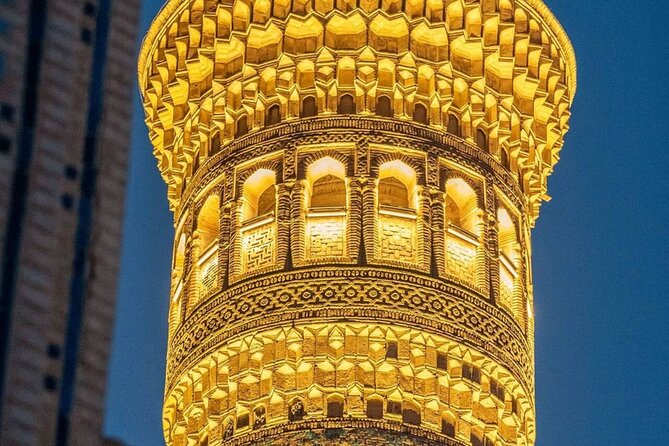
You also see the Kalta Minor Minaret, the short, broad tower covered in turquoise tile. Its unusual shape comes from an unfinished project. The planned tower was intended to be much taller, but work stopped after the death of its patron, Mohammed Amin Khan.
Khiva is a strong opening to the tour because the main sights feel connected. The drawback is the early flight. You will probably arrive tired, and the day still includes several hours of walking and structured visits. Wear shoes with good support and keep water close, especially during warmer months.
Day 3: The long rail journey from Khiva to Bukhara
After breakfast, you transfer to Khiva railway station at 10:00 for an 11:10 train to Bukhara. The scheduled arrival is 6:14 p.m., so this is roughly a full day in transit.
The journey crosses the Kyzylkum Desert and follows part of the old Silk Road corridor. The train is not just a way to get from one hotel to another. It gives you a long look at the dry interior of Uzbekistan, with time to rest after the demanding Khiva schedule.
The transport notes describe this train as a regular service. High-speed tickets are included for parts of the wider route, but availability can affect the final arrangements. If you book less than 60 days before departure, the operator may replace a high-speed train with the most comfortable available regular train or another form of transport.
That warning is worth taking seriously. The tour is often booked around 50 days in advance, but booking earlier gives you a better chance of securing the intended rail schedule and a guide who speaks your preferred language. English-speaking guides may be used if another language is unavailable.
A driver meets you at Bukhara station and takes you to the hotel. The evening is free, which is welcome after the long ride. You may have time for a short walk or dinner, but I would not plan anything demanding.
Same city, a different kind of day:
- Best of Tashkent Mountains: Amirsoy, Chimgan & Charvak Trip
★ 4.8 · 567 reviews - Samarkand One Day Tour – Departure From Tashkent
★ 5.0 · 313 reviews - Tashkent City Tour
★ 5.0 · 121 reviews - Amirsoy, Chimgan & Charvak Full-Day Adventure
★ 4.9 · 82 reviews
Day 4: Bukhara’s mosques, markets, and old center
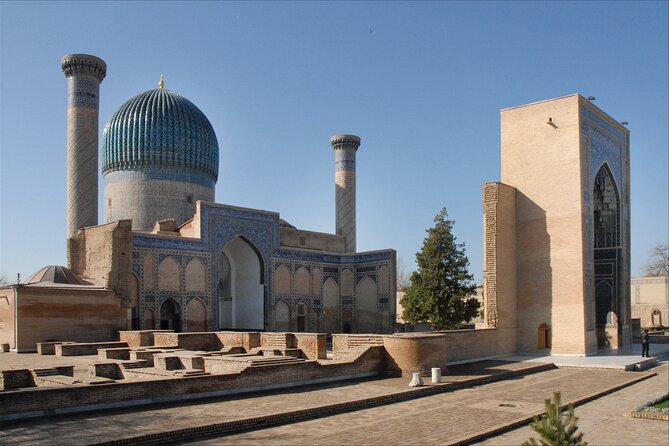
Bukhara gets the fullest sightseeing treatment. You meet the guide at 9:00 a.m. and visit a dense group of monuments before taking the 4:24 p.m. train to Samarkand.
The day begins with the Ulugbek Madrasah, built in 1417 by Mirzo Ulugbek, the astronomer and ruler who also appears later in Samarkand. It is one of the oldest surviving madrasahs in Central Asia, and it gives useful context for the intellectual life of the region.
At the Bolo Hauz Mosque, look for the tall carved wooden pillars at the entrance. The mosque is next to a small pond, and the setting feels different from Bukhara’s larger monumental complexes.
The Chor Minor Madrasah is a compact and unusual building with four small tower-like forms topped by blue domes. It is not the largest stop of the day, but its shape makes it easy to remember.
The Ark of Bukhara is the city’s great fortress. The visit is listed at 30 minutes, though the fortress contains several museums and can reward a longer look if your schedule allows. I would ask the guide which sections are open and most worthwhile that day.
The Lyab-i-Hauz ensemble brings together a pool, the Nadir Divanbegi Madrasah, a khanaka, the Kukeldash Madrasah, and a monument to Khodja Nasreddin. This is one of the better places to pause and take in how water, public space, and religious buildings shaped old Bukhara.
The Poi Kalyan complex contains the Kalyan Mosque, the Great Minaret of the Kalyan, and other major structures built across several centuries. The minaret is one of Bukhara’s defining sights, and its scale is best appreciated from the open space around the complex.
You also visit the Mir-i-Arab Madrasah, still used as an operating religious school, and the trading domes, Maghak-i Attari Mosque, and Chasma Ayub Mausoleum listed in the day’s fuller program. Some stops have only 20 or 30 minutes, so this is more a guided overview than an unhurried study of every interior.
The 4:24 p.m. train to Samarkand arrives at 6:07 p.m. A transfer takes you to the hotel, with free time afterward. This is an efficient day, but it leaves little room for spontaneous shopping or long café stops.
Day 5: Samarkand’s grandest monuments
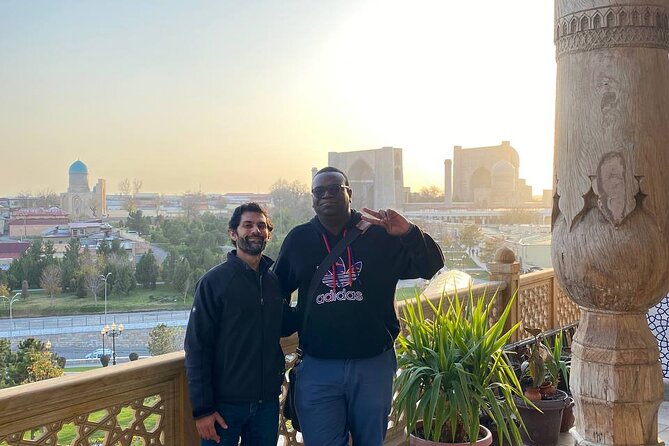
Samarkand is the architectural high point of the trip. After breakfast, you meet the guide at 9:00 a.m. for a full day of sightseeing, then take the 6:32 p.m. train back to Tashkent.
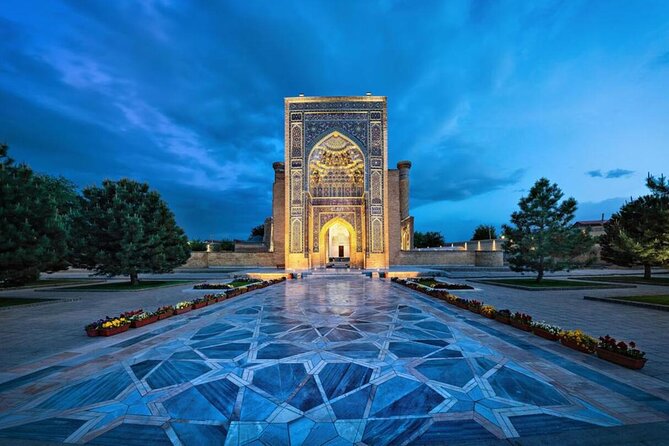
Begin at the Gur Emir Mausoleum, the resting place of Tamerlane. Its blue-domed exterior and interior decoration introduce you to the visual style that reaches its fullest expression at the Registan.
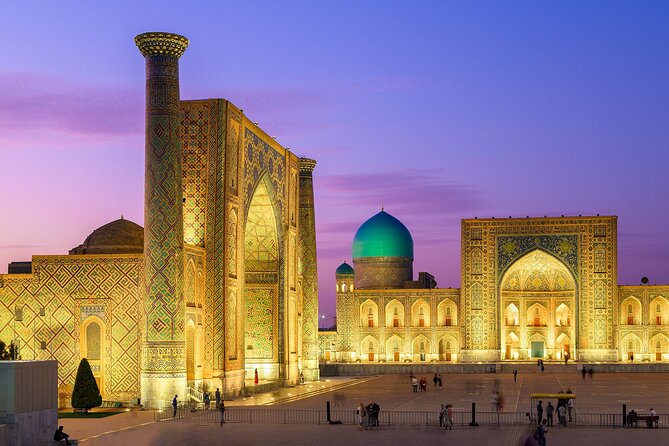
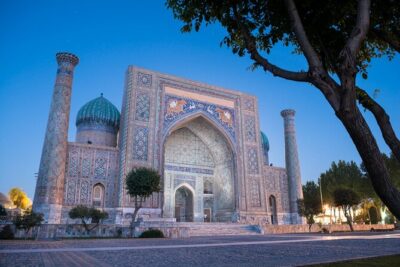
The Registan is Samarkand’s great square, framed by the Ulugbek, Sherdor, and Tilla Kori madrasahs. One hour is allocated here, enough for a guided introduction and photographs, though you may wish you had more time to examine the tile work and courtyards at your own pace.
The Bibi Khanym Mosque was among the largest and most impressive mosques of its era. The enormous scale is the point, especially when you view it from the broad area near the entrance.
Next comes Siyob Bazaar, Samarkand’s largest market. This is a good change of pace from formal monuments. Look for Samarkand naan and other everyday goods, and use the hour to see how the city functions beyond its historic center.
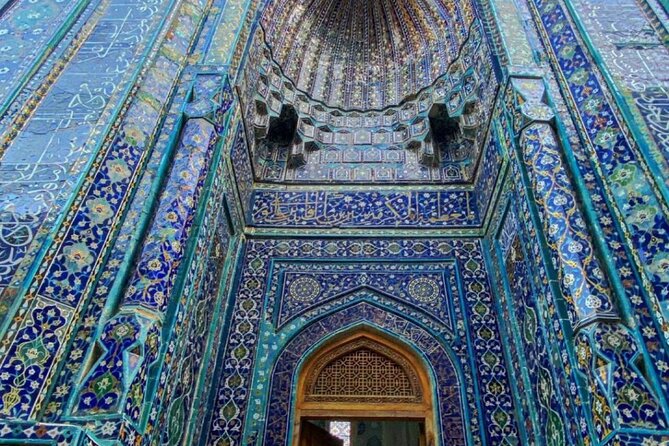
The Shah-i-Zinda Ensemble is a line of mausoleums and ritual buildings from the 11th through the 15th centuries, with later additions as well. It is one of the most detailed and visually varied stops of the day, but the route includes stairs and walking, so plan accordingly.
At the Ulugh Beg Observatory, you learn about the astronomer-ruler’s work in the 1420s. The observatory adds scientific context to Samarkand, showing that the city’s importance was not limited to palaces, mosques, and trade.
A light and sound show at Registan may be included if available. The wording matters: it is not guaranteed. The same applies to the folklore performance at Nadir Divanbegi Madrasah in Bukhara.
After the sightseeing day, you transfer to Samarkand station for the evening train to Tashkent, arriving at 8:45 p.m. You spend the night in Tashkent before your departure.
Day 6: Tashkent beyond the monuments
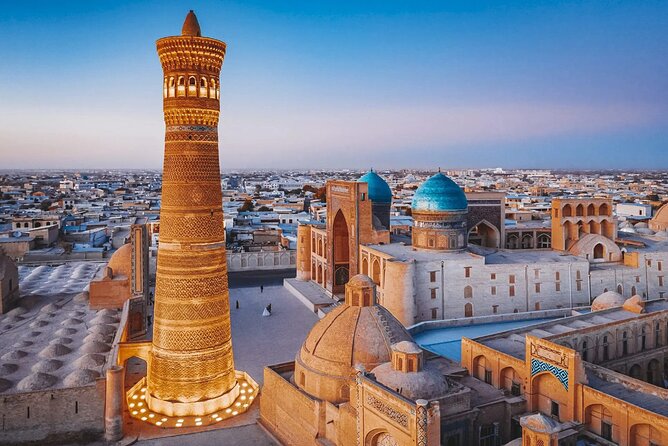
The final sightseeing day starts at 9:00 a.m. and covers a different side of Uzbekistan. Tashkent is a modern capital as well as an old city, so the program mixes religious sites, public squares, museums, markets, and the metro.
The Amir Temur Museum focuses on Tamerlane and the Timurid period. Its central rotunda contains a copy of the Quran, a painted backdrop, a gold-colored domed ceiling, and a large chandelier. The visit lasts about an hour.
At Amir Temur Square, you see a major public space renamed in 1994 to honor Amir Timur. Independence Square adds a political and civic view of the country, with fountains, government buildings, and an eternal flame.
The Hazrati Imam religious center includes the Barakkhan Madrasah, Kaffal Shashi Mausoleum, and the Islamic Literature library, which holds the seventh-century Quran associated with Othman. This is one of the more significant religious stops on the route, so dress respectfully and follow the guide’s instructions.
Kukeldash Madrasah dates from 1570 and offers another example of Islamic architecture in the capital. Chorsu Bazaar is less formal and more sensory, with local trade and daily necessities gathered beneath its large market structure.
The Courage Earthquake Memorial commemorates the April 26, 1966 earthquake and sits near the reported epicenter. It gives the day a human and modern historical focus.
The full program also includes Minor Mosque, the Museum of Applied Art, and Tashkent’s metro. The metro is especially worthwhile because the stations have different architectural and artistic designs. The supplied schedule also refers to a mosque and a decorative arts museum, though the stop descriptions are brief, so ask your guide how much time is available at each.
After sightseeing, you transfer to Tashkent International Airport. The departure time is not specified, so provide your flight details when booking and confirm the final transfer timing.
What the $765 price really covers
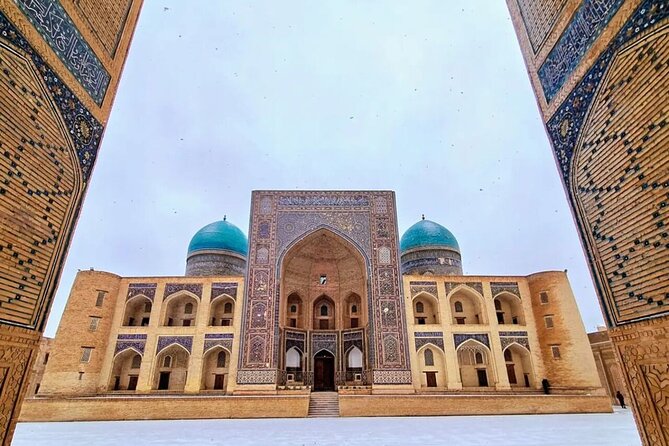
At $765 per person, the value depends on how much you would otherwise spend arranging a domestic flight, four city transfers, three rail journeys, five hotel nights, admission fees, and local guides.
The package includes air-conditioned transportation, hotel-to-hotel transfers, a domestic Tashkent to Urgench flight, train tickets, a tour director, local guides, and entry fees listed in the program. You also receive one lunch at Besh Qozon, a major plov restaurant in Tashkent.
Lunches apart from that meal and all dinners are not included. You should set aside extra money for food, drinks, and any personal purchases. An e-visa, if required for your nationality, is also extra.
The private format adds value if you prefer control over the pace or are traveling with family or friends. Group discounts are available, and the tour can be customized. For a solo visitor, the cost may feel higher than joining a group, but the included transport and private handling can make the price reasonable for such a compressed route.
Who should book this six-day schedule?
I would recommend it to a first-time visitor who wants the major historic cities without managing Uzbek flights, stations, transfers, and admission tickets alone.
It suits people who are comfortable with early mornings, long sightseeing days, and fixed transport times. It is also a good fit for families or small groups who want their own guide and vehicle rather than a large coach.
I would hesitate to recommend it to anyone who wants slow mornings, long meals, or several hours to wander each historic center alone. Bukhara and Samarkand in particular deserve more time than this schedule allows, and Khiva’s early flight makes Day 2 demanding.
The free-cancellation policy is useful: you can cancel for a full refund up to 24 hours before the experience begins. Changes made within 24 hours are not accepted, and the amount paid is not refunded.
Should you book it?
Book this tour if your main goal is to see Uzbekistan’s essential historic cities in one efficient sweep. The strongest features are the private format, included transport, broad sightseeing coverage, and the support available when plans change.
Before paying, confirm the hotel names, train class, guide language, flight details, and whether the Registan light show and Bukhara folklore performance are available. If you can book more than 60 days ahead, do so, especially if high-speed rail or a non-English guide matters to you.
If you have only six days and want the practical work handled for you, this is a strong value. If you can spare ten days or more, I would prefer a slower version with extra nights in Khiva, Bukhara, and Samarkand.
FAQ
How long is the tour?
The tour lasts approximately six days and includes five nights in three-star hotels.
Where does the tour begin and end?
It begins with pickup at Tashkent International Airport and ends with a transfer to Tashkent International Airport on Day 6.
Is this a private tour?
Yes. Only your own group participates.
Is transportation included?
Yes. The package includes hotel-to-hotel transfers, air-conditioned vehicles, a domestic flight from Tashkent to Urgench, and train tickets for the listed rail journeys.
Are entrance fees included?
Yes. Entry fees according to the tour program are included.
Are meals included?
One lunch at Besh Qozon is included. Other lunches and all dinners are not included.
Can the tour be customized?
Yes. The tour can be customized.
What happens if high-speed train tickets are unavailable?
If high-speed tickets are unavailable, particularly when booking less than 60 days before departure, they may be replaced by the most comfortable available regular train tickets or another form of transport.
Just added in Tashkent
- Uzbekistan Tour – 6 Days 5 Nights★ 5.0 · 4 reviews
- Tashkent-Samarkand-Bukhara tour-3nights/4 days★ 5.0 · 5 reviews
- Private Intercity Transfer Tashkent – Samarkand – Tashkent★ 3.5 · 3 reviews
- Tashkent City Tour with Hotel Pickup and Drop off★ 4.5 · 4 reviews
- Tashkent Food and Metro Journey★ 5.0 · 4 reviews
- Tashkent Mountain Tour Amirsoy with Transport★ 3.5 · 3 reviews
- Private Tashkent City Tour★ 5.0 · 3 reviews
- Silk Road Secrets Tour in Uzbekistan★ 5.0 · 4 reviews
Tours in Tashkent, compared.
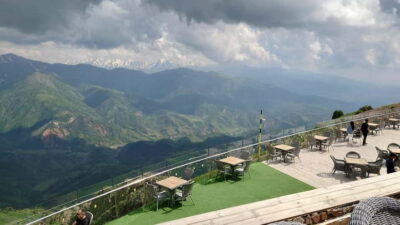
Best of Tashkent Mountains: Amirsoy, Chimgan & Charvak Trip
Read our review →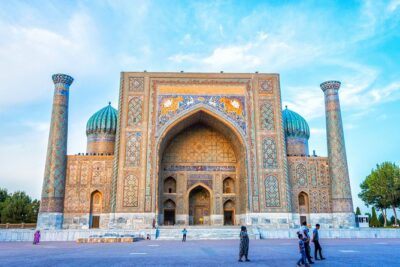
Samarkand One Day Tour – Departure From Tashkent
Read our review →
2 Days Tour to Bukhara and Samarkand from Tashkent by train
Read our review →
Uzbekistan 6 days private tour Tas-Khiva-Buk-Sam-Tas
Read our review →
Uzbekistan 8 Days Private Tour Tashkent-Urgench-Bukhara-Samarkand-Tashkent
Read our review →Browse the lists this tour appears in