
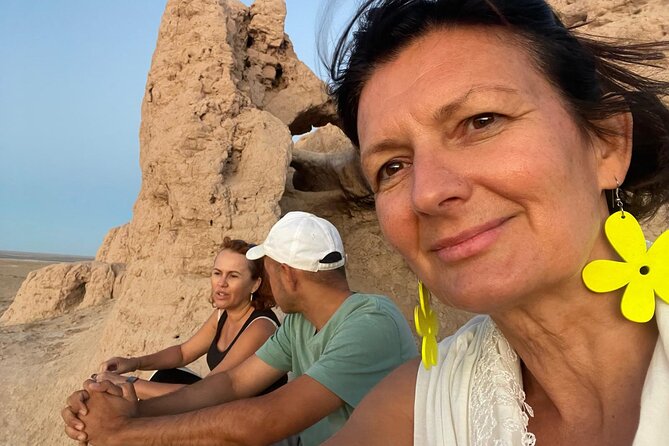
Reviewed · ARAL SEA TOURS
Aral Sea – Extended trip (3 days)
The most striking part of this trip is the sheer change of scene. In three days, you move from Khiva’s old city to the dry Aral Sea shore, the ship cemetery at Muynak, remote Ustyurt country, desert camps, and a long line of Khorezm fortresses. This is a serious road trip, not a quick photo stop.
I like the private format and the chance to see places that are hard to reach without local drivers. I also like the mix of archaeology, ecology, village life, and a night in a yurt. The main drawback is simple: more than 1,200 kilometers in three days means long hours in the car, rougher roads, and a brisk pace.
Key points to know before booking
- More than 1,200 kilometers in three days: Expect substantial driving between widely scattered sights.
- Two vehicles are used: A sedan and a 4×4 handle the paved roads and desert conditions.
- The Aral Sea story is seen up close: Muynak’s ships, museum, former shoreline, and local environment give the trip real weight.
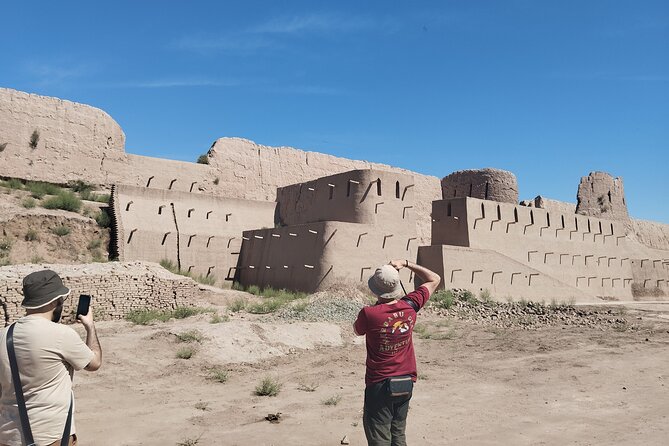
- The fortresses come in a remarkable sequence: Chilpik, Ayazkala, Toprakkala, Kyzylkala, Guldursun, Koi Krylgan Kala, and others fill the route.
- Yurt nights cost extra: The two desert stays together cost $90 per person, including dinner.
- This is private and flexible: Your group can include up to three people, with pickup and drop-off arranged in Khiva, Urgench, or Nukus.
Why this three-day route is worth the long road
This journey gives you a much broader picture of western Uzbekistan than a standard Khiva stay. Khiva’s Itchan Kala is polished and compact. Karakalpakstan is the opposite: wide, dry, sparsely settled, and full of sites that require patience to reach.
I like that the route does not treat the Aral Sea as a single viewpoint. You see the former waterline, the ships left behind at Muynak, a small regional museum, salt marshes, lakes, and the Ustyurt Plateau. Each stop adds another piece to the story of a sea that once supported a major fishing economy.
The archaeological stops add a second thread. Ancient Khorezm was dotted with fortified towns, royal centers, religious sites, and settlements. The remains are often open, quiet, and lightly interpreted. That can be a plus if you enjoy atmosphere and empty horizons, but you should not expect polished museums or extensive signs at every ruin.
The price is $899 per group of up to three people. Split between three, that is roughly $300 per person before accommodation, meals, and entrance tickets. For a private vehicle arrangement covering this distance, the value is reasonable, especially if you want flexibility and do not want to arrange several remote transfers yourself. For one person, the same price feels much less attractive.
Other trips out to the Aral from Khiva:
- Aral Sea Adventures (2 day)
★ 5.0 · 30 reviews - From Khiva To Aral Sea 2-Days One Night In Yurt Stay
★ 4.6 · 20 reviews - Daytrip From Khiva to Aral Sea Cemetery Of Ships . All In One
★ 4.5 · 18 reviews
Day one: Chilpik, Nukus, and the vanished shoreline
The tour begins at 6:00 am at the west gate of Itchan Kala in Khiva. That early start is necessary. The first day combines a Zoroastrian monument, Nukus, Muynak, and the Aral Sea area before an overnight stay.
Chilpik Qala is a round, roofless tower more than 2,200 years old. It rises about 15 meters and measures roughly 65 meters across. Built as a Zoroastrian dakhma, it was connected with funerary practices, and its isolated position makes the site feel especially stark.
You get about 30 minutes here. That is enough to see the structure and take in the setting, but not enough for a leisurely archaeological visit. The fortress entrance is not included, and small admission charges apply at several sites on the route, so carry Uzbek som or other convenient payment.
Nukus brings a sudden change. The State Museum of Art named after I. V. Savitsky is the cultural heavyweight of the trip. Its collection is famous for Soviet-era art that was overlooked, restricted, or difficult to show elsewhere. You have about an hour inside, and the $7 entrance fee is separate.
I would not skip this museum unless you have already visited it. It gives the route a strong human and artistic counterpoint to the desert ruins. The museum is also one of the few stops where you will spend time indoors with a substantial collection, so it is a useful break from the road.
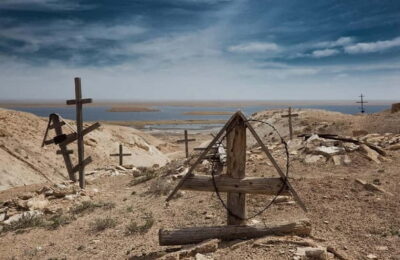
After Nukus, the route heads toward Muynak and the Aral Sea region. The shore you see today is not the old shoreline remembered by residents. Depending on the exact access point and conditions, you may see dry ground, low hills, exposed rocks, and the remains of the former sea environment. The scheduled shore visit lasts about an hour and is free.
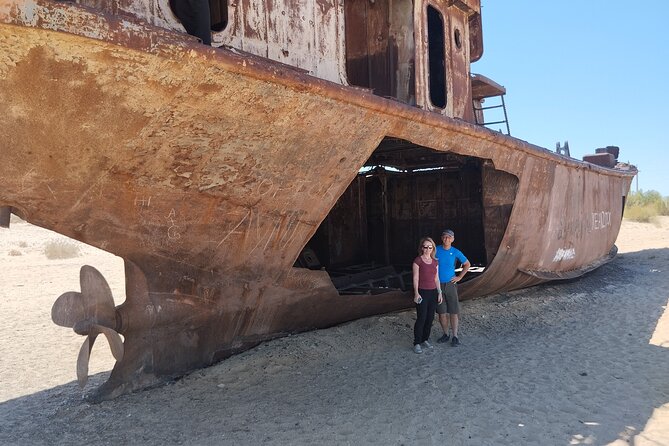
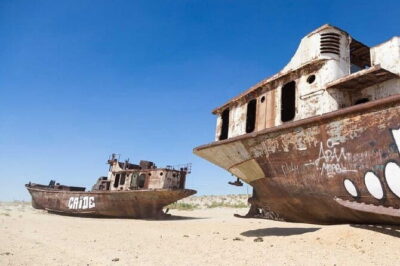
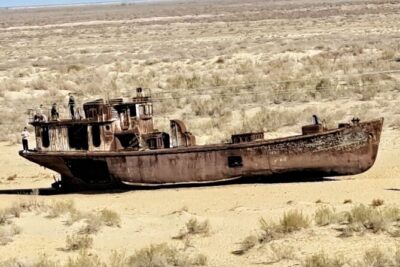
The Muynak ship cemetery is one of the clearest visual symbols of the Aral Sea disaster. Rusting vessels sit far from the water that once carried them. The image is powerful, but it is worth looking beyond the photograph. Muynak was once tied to fishing and maritime work. The ships show how quickly an entire local economy can lose its purpose.
The Muynak Regional History and Aral Sea Museum adds local context. It is a modest museum, with about 30 minutes planned, and admission is listed as free in the tour details. The museum helps explain the environmental change and the lives affected by it. I would treat this stop as essential, even though it is smaller than the Savitsky Museum.
The first day is also the most emotionally heavy. You are not simply visiting an unusual desert site. You are seeing the remains of a large ecological and economic collapse. Bring water, sun protection, and patience for the long transfers between stops.
Day two: Sudoche Lake and the Ustyurt backcountry
The second day moves farther from the familiar tourist circuit. Sudoche Lake is a natural lake near the Aral Sea with birdlife and plant life that contrast sharply with the surrounding dry country. You have about an hour here.
Sudoche is valuable because it prevents the Aral Sea story from becoming only a tale of loss. The region still contains water, habitat, and seasonal life. The nearby areas of Urga and Qibla Ustyurt are remote, and access depends on road and weather conditions.
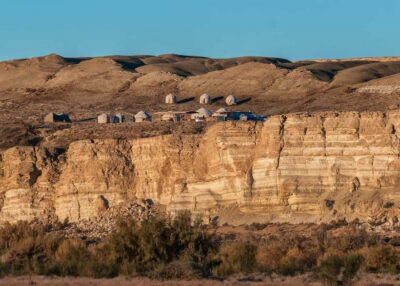
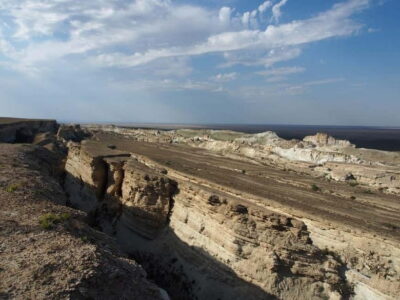
Qibla Ustyurt opens the door to the Ustyurt Plateau. This is where the 4×4 matters most. The route includes several remote attractions, including Kurgancha Kala, a fortress associated with the 13th century, and areas around the plateau’s canyons and settlements.
The tour description lists a number of Ustyurt points, including Urga, Kurgancha Kala, Qibla Ustyurt, and the canyons. The exact amount of time at each place can vary because this is a very long circuit. You should think of this section as a desert expedition by road, not as a neatly timed museum day.
Barsakelmes is a salt marsh covering about 1,000 square kilometers. Salt is harvested there today, and the place lies roughly 200 kilometers from Nukus. Its name is often translated as a place of no return, a reference to its distance and isolation.
The planned stop is only about 20 minutes, so you will not have a full exploration of the marsh. Still, it is an unusual addition to the route and helps show how varied the Aral region can be. Water, salt, ruined settlements, former seabed, and open desert all appear within the same broad journey.
Mizdakhan Necropolis is another short but important stop. This ancient cemetery lies near the remains of Gyaur Kala and is one of Karakalpakstan’s major pilgrimage sites. You have about 30 minutes. The site is best approached with respect, since it is not simply an archaeological ruin but also a place connected with religious memory.
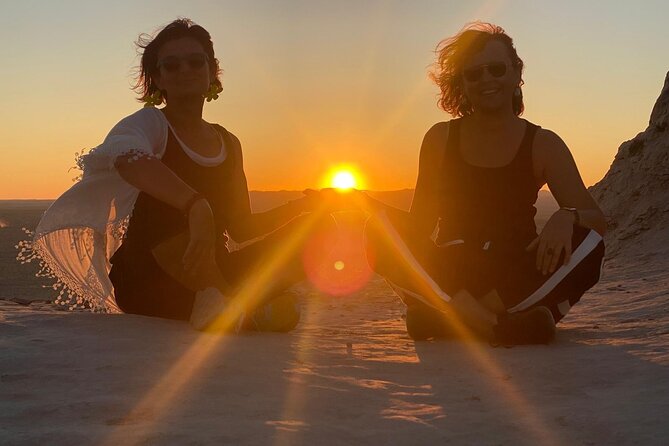
Day two ends near Ayazkala, with an overnight stay in a yurt camp. The yurt accommodation costs $50 per person and includes dinner. The Aral Sea yurt camp costs $40 per person, also with dinner, bringing both nights to $90 per person.
A yurt stay is one of the trip’s strongest features, but it is not a hotel substitute. You are choosing location, desert atmosphere, and a night under a broad sky over private-room convenience. One review specifically praised desert food and star watching, and those are exactly the details that make the overnight stops worthwhile.
Day three: Ayazkala and the fortress chain
The third day focuses on ancient Khorezm. Ayazkala is the main event, with about an hour scheduled. The complex includes hilltop fortifications overlooking the Kyzylkum Desert, with construction and use spanning from the 4th century BCE to the 7th century CE.
The setting is as important as the walls. From the high ground, the ruins make sense as defensive structures placed above a broad, exposed area. You can walk around the remains, but the heat, wind, and uneven ground mean you should have a moderate level of fitness and sturdy shoes.
Toprakkala follows. Dated mainly to the Kushan period, around the 2nd and 3rd centuries CE, it served as a royal center of Khorezm. The visit is planned for about 30 minutes, and entrance is not included. At many of these fortresses, your enjoyment will depend on your ability to picture the missing parts: walls, rooms, towers, and daily life are often suggested by foundations rather than preserved in full.
Guldursun Qala is a fortified town with exterior walls and towers dating to the 12th century. Archaeological work found pottery, bronze objects, and coins inside. The stop lasts around 20 minutes and is free.
Kyzyl Kala is also scheduled for about 20 minutes, with a separate entrance fee. The information provided for the route describes the fortress as having an earlier late antique phase and later rebuilding in the 12th and 13th centuries. These short visits can feel repetitive if you are not interested in ancient architecture, so I would read a little about Khorezm before leaving Khiva.
Koi Krylgan Kala brings a different kind of interest. Its name is often rendered as Forty-Fortress, and the site is connected with ancient religious and ceremonial use. The supplied route information places it among the late antique fortresses and includes it as a free stop. Expect about 20 minutes.
Angka Kala is another settlement with two broad periods of occupation, from the 1st to 3rd centuries and again from the 10th to 12th centuries. It lies about 22 kilometers north of Turtkul and has a nearly square plan. The walls are described as relatively well preserved, though your time here is again about 20 minutes.
The final listed stops include Duman Kala and the Itchan Kala area. Duman Kala is described as having three connected parts: a square western enclosure, a smaller citadel, and a northern enclosure. The itinerary labels the final stop as Itchan Kala, so confirm the precise end point and sequence with Oxus Travel before departure, especially if you need to connect with a train or flight.
This last day is rich in ruins but light on interpretation. An audio guide is included, and a guide with historical interests can make a major difference. Olimjon is identified as an educated historian and warm host in the tour information. If he is assigned to your departure, ask him to explain how the fortresses relate to one another rather than treating each one as a separate pile of walls.
A few more things worth doing in Khiva
- Uzbekistan 3 Day Private Tour Tashkent-Bukhara-Samarkand Bullet Train
★ 4.5 · 23 reviews - Desert yurt camp and Mountain tour – 3 days
★ 4.5 · 15 reviews - 3-Day Chimgan Trekking Tour
★ 5.0 · 10 reviews - Tashkent: 3-Day Horseback Riding Tour in Chimgan Mountains
★ 4.4 · 3 reviews
Vehicles, pace, and comfort on 1,200 kilometers
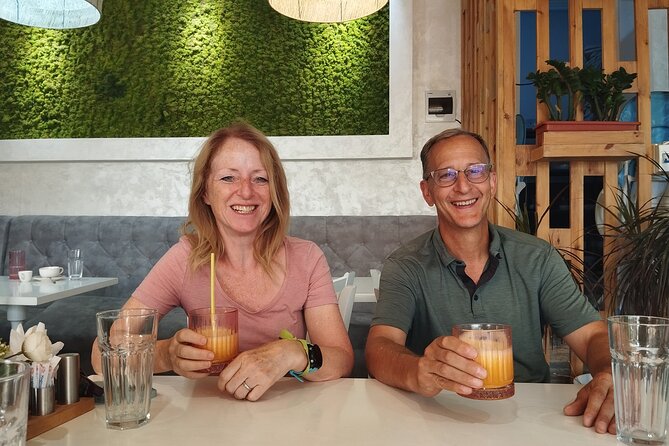
The tour uses two cars, one sedan and one 4×4. That arrangement reflects the route’s mixed conditions. The sedan is suitable for regular roads, while the 4×4 is intended for rougher desert access.
You are promised air conditioning and private transportation, but air conditioning does not remove the main challenge: distance. More than 1,200 kilometers over three days means long stretches between sights. Transportation time is included in the stated duration, so do not picture three full days of sightseeing.
The drivers are described as experienced with desert conditions and smooth driving. That matters on rough tracks, where a careful driver makes the ride less tiring. Still, you should expect dust, vibration, and uneven surfaces. If you suffer from motion sickness, bring the medication that works for you.
The physical requirement is moderate. You do not need to be an athlete, but you will walk around uneven ruins, climb or approach raised sites, and cope with sun and wind. The minimum age is 15.
What the $899 price really covers
The $899 price applies to a private group of up to three people. Included are hotel pickup and drop-off, air-conditioned vehicles, private transport, and audio guide materials.
You pay separately for:
- The two yurt nights, $90 per person total, including dinner
- Savitsky Museum admission, $7 per person
- Muynak Aral Sea Museum admission, $3 per person
- Fortress entrances, generally around $2 each
- Lunches
For three people, the base cost works out well for a route this long. You are paying for private transport across a difficult region and avoiding the trouble of arranging separate drivers, desert access, and overnight stops. For two people, the cost is still defensible if convenience matters. For one person, I would compare it with a shorter shared trip or a custom arrangement.
The extra costs are not large, but the total should be clear before you book. Carry lunch money and budget for several small fortress fees. Dinner is included with the yurt accommodation, but lunch is not.
Who should book this trip
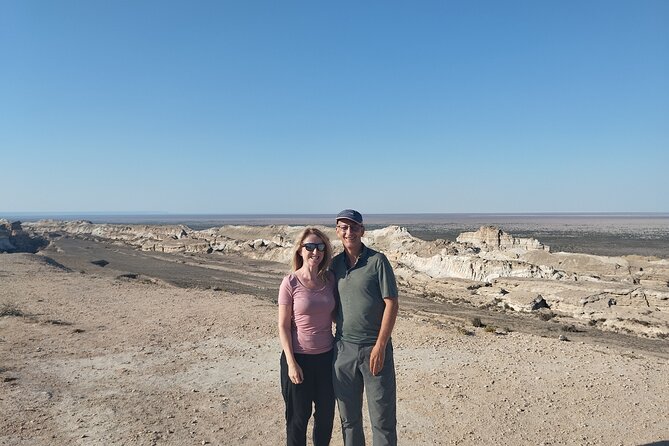
You should book this if you want the Aral Sea story, remote desert country, and Khorezm archaeology in one ambitious journey. It suits people who enjoy long drives when the destination is unusual, and it works especially well for a private group of two or three.
You should think twice if you dislike rough roads, early starts, basic accommodation, or repeated short visits to ruins. A slower trip would give more time at the Savitsky Museum, Muynak, and the larger fortresses, but it would also require more days.
The tour can start or finish in Khiva, Urgench, or Nukus by arrangement. That flexibility is useful if you are building a wider Uzbekistan itinerary. Confirm the exact pickup and final drop-off location before you pay, particularly if your transport plans are tight.
Cancellation is free up to three full days before the start time. Changes made inside that period are not accepted, and poor weather can lead to a new date or a full refund. This matters because remote desert driving depends more on conditions than a city sightseeing tour does.
Should you book it?
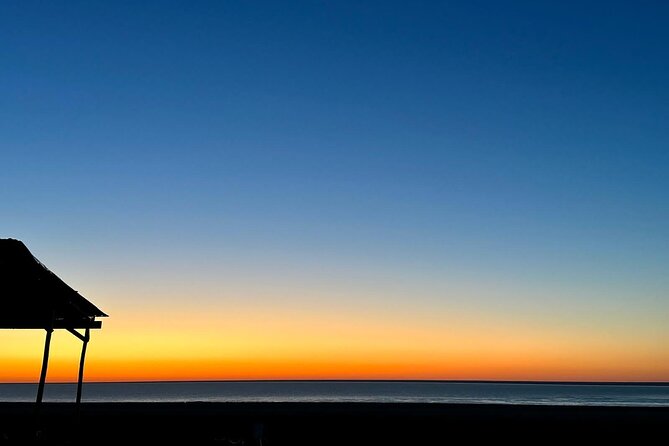
I would book this trip if you have three days, a small private group, and a real interest in the Aral Sea and ancient Khorezm. The best parts are the combination of Muynak’s ship cemetery, the Savitsky Museum, the remote Ustyurt route, and the yurt nights.
I would not book it as a relaxed escape from Khiva. The schedule is demanding, the driving is substantial, and several fortress visits last only 20 minutes. Go for the scale, the strangeness, and the chance to see western Uzbekistan beyond the postcard version. If that sounds like your kind of adventure, the $899 group price is fair.
FAQ
Where does the tour start?
The scheduled meeting point is the west gate of Itchan Kala in Khiva, at 6:00 am.
Can the tour start or finish in another city?
Yes. The route can start or finish in Khiva, Urgench, or Nukus, depending on your arrangement with the provider.
How many people can join the private tour?
The price covers a private group of up to three people.
Are the yurt stays included in the $899 price?
No. Accommodation costs extra. The Aral Sea yurt camp costs $40 per person, and the Ayazkala yurt camp costs $50 per person. Both include dinner.
What entrance fees are extra?
The Muynak Aral Sea Museum costs $3 per person, the Savitsky Museum costs $7 per person, and fortress entrances are generally around $2 each.
Is lunch included?
No. Lunch is not included in the tour price.
How far do you travel by car?
The route covers more than 1,200 kilometers over three days. Transportation time is included in the overall tour duration.
Just added in Khiva
- Uzbekistan 6 Days Private Tour Khiva-Bukhara-Samarkand by Train★ 5.0 · 4 reviews
- Traditional Khiva Cooking Class with Market Visit & Lunch★ 5.0 · 4 reviews
- Old Khiva Stories with Your Local Guide★ 5.0 · 5 reviews
- Master Class – Uzbek Bread (Khiva)★ 3.5 · 4 reviews
- A Night In The Kyzylkum Desert [2] From Khiva★ 4.5 · 3 reviews
- Khorezm Fortress and KyzylKum Desert Private Tour★ 5.0 · 3 reviews
- Best of Khiva: Exclusive Private Tour!★ 5.0 · 3 reviews
- Daytrip From Khiva To Ancient Fortresses★ 4.6 · 60 reviews
Aral Sea Tours, compared.
Daytrip from Khiva to Aral Sea Cemetery of Ships. All in one
Read our review →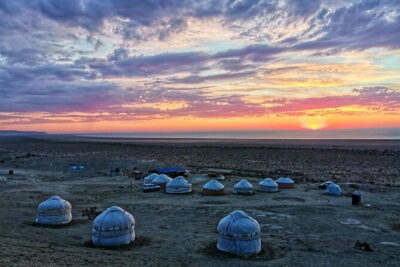
Browse the lists this tour appears in