
Reviewed · TOURS IN TASHKENT
Discover Uzbekistan – explore top destinations: Samarkand, Bukhara & Tashkent
Uzbekistan’s big three cities come in one ambitious sweep here: Tashkent’s museums and monuments, Bukhara’s old Islamic architecture, and Samarkand’s grand Timurid squares. The high-speed rail plan saves you from long road transfers, while included tickets, meals, guides, and admission fees keep the trip easy to price.
I especially like the small maximum group of eight and the strong range of sights. You see the Kalyan Minaret, Ark of Bukhara, Gur-i Amir, Registan, and Shah-i-Zinda, not just a quick photo stop. The catch is pace: three cities in three days means early starts, train connections, and limited time at each monument.
The essential points at a glance
- Three famous cities in three days: Tashkent, Bukhara, and Samarkand are linked in one tightly scheduled route.
- High-speed rail included: Economy-class train tickets cover Tashkent to Bukhara, Bukhara to Samarkand, and Samarkand to Tashkent.
- Small group size: The maximum is eight people, with pickup offered.
- Major monuments included: You visit the Registan, Kalyan Minaret, Ark of Bukhara, Bibi Khanym Mosque, and Shah-i-Zinda.
- Meals and admissions are covered: Three breakfasts, three lunches, entrance tickets, and an air-conditioned vehicle are included.
- Guiding may vary by city: Names connected with the operation include Sevinc in Samarkand and Outilla in Tashkent, with Ibrohim and Izzatullo associated with wider arrangements.
Why this three-day route is appealing
The greatest strength is simple: you see a lot of Uzbekistan without having to build the trip yourself. Rail tickets, local transport, entrance fees, meals, and guiding are bundled into one $999 price. That matters in a country where city-to-city planning can take time, especially when you want to combine several major destinations.
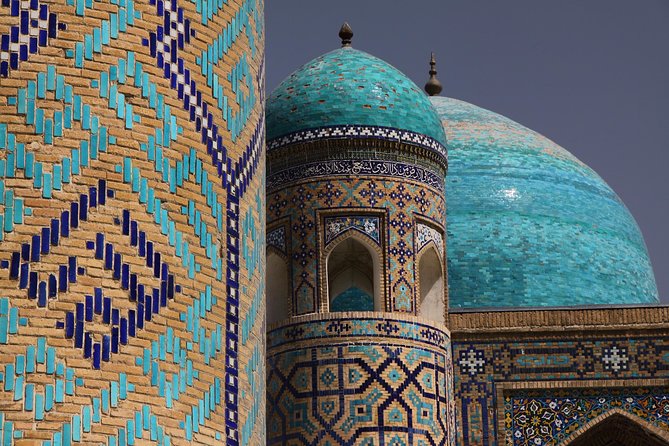
The route also gives each city a different flavor. Tashkent is the modern capital, with broad squares, museums, memorials, and newer Islamic architecture. Bukhara feels more concentrated and architectural, with mosques, madrasas, trading-era monuments, and the old Ark fortress. Samarkand brings the grandest visual finish, with the blue-tiled Registan and the famous mausoleums of the Timurid period.
This is not a slow trip. The listed visits often last 20 or 30 minutes, with one hour at the Ark of Bukhara. That timing lets you see many places, but it does not leave much room for lingering, long museum visits, or spontaneous wandering. I would choose this plan if your time in Uzbekistan is short and your first goal is to cover the major sights.
Other tours people book in Tashkent:
- Best of Tashkent Mountains: Amirsoy, Chimgan & Charvak Trip
★ 4.8 · 567 reviews - Samarkand One Day Tour – Departure From Tashkent
★ 5.0 · 313 reviews - Tashkent City Tour
★ 5.0 · 121 reviews
Day one: Tashkent’s squares, museums, and white mosque
The first day begins in Tashkent, Uzbekistan’s capital. The city’s attractions are spread across broad public spaces and museum districts, so the included air-conditioned vehicle is useful. You are not simply walking from one old monument to the next.
At the Amir Timur Museum, you get a compact introduction to the 14th-century ruler Tamerlane, known locally as Amir Temur. The modern domed building contains portraits and artifacts connected with his rule. Thirty minutes is enough for an overview, but not for a careful study of every display.
Nearby, Amir Temur Square places the ruler at the center of a large urban setting. The equestrian statue is surrounded by formal esplanades, giving you a sense of how Timur remains part of Uzbekistan’s public identity. The stop lasts about 20 minutes, so think of it as a city orientation and photo opportunity rather than a full historical visit.
Independence Square, also called Mustakillik Square, shifts the focus from medieval empire to modern Uzbekistan. It is one of central Tashkent’s main civic spaces. The nearby Memorial Square honors soldiers who died during the Great World War, adding a more solemn note to the day.
The Courage Earthquake Memorial recalls a major event in Tashkent’s modern story. The monument is a historical landmark, and its short visit works well alongside the city’s larger public squares. These stops help you see Tashkent as a capital shaped by both Soviet-era planning and newer national symbols.
The Minor Mosque offers a change of mood. Its bright white exterior and Islamic design make it one of the more visually striking stops in the capital. A 30-minute visit gives you time to appreciate the architecture without turning the day into a long religious-site tour.
The final stop is the Uzbekistan State Museum of Applied Art. For me, this is one of the most useful visits in Tashkent because applied art gives you a look at local design beyond monumental buildings. The tour allows about 30 minutes, so ask your guide what displays deserve your attention if you want to use the short visit well.
Tashkent’s first day is varied, but it can feel like a checklist. You move from square to memorial to museum, with little time for a long café break or independent exploration. The payoff is a broad introduction to the capital before the route shifts to Bukhara’s older architectural core.
Day two: Bukhara’s mosques, madrasas, and ancient fortress
Bukhara is the architectural heart of the middle day. The route gathers many of the city’s best-known monuments, and the compact center makes this portion feel more connected than the Tashkent sightseeing.
The first stop is the Lyabi House area, the setting around the Lyabi-Hauz ensemble. Three large buildings frame the historic complex: Kukeldash Madrasah to the north, a khanaka and the Nodir Devonbegi building to the west, and another historic structure to the east. The name refers to the pool area, and the setting helps you understand how Bukhara’s religious and civic buildings worked together.
The Nodir Devonbegi Madrasah sits near Lyabi-Hauz and was built by order of the vizier Nadir. The nearby khanaka is tied to the same patron. You have only about 20 minutes here, so focus on the facade, layout, and decorative details rather than trying to absorb every piece of background.
The Kalyan Minaret is one of Bukhara’s unmistakable landmarks. It belongs to the Po-i-Kalyan complex and rises above the surrounding city. The visit is short, but the minaret’s scale and setting make it memorable. The neighboring Poi Kalyan Mosque adds the larger religious context. Dating to the 15th century, it is one of Bukhara’s major monuments.
The Ulugbek Madrasah introduces another Timurid connection. An inscription on its bronze door plate dates its founding to 1417. This is a worthwhile stop for visitors interested in the link between architecture, education, and the scientific interests of Ulugbek, Timur’s grandson.
The Mir-i-Arab Madrasa is another highlight of the Bukhara sequence. It is considered one of the city’s most interesting monuments, and its facade adds another layer of tilework and proportion to the day. The scheduled 30 minutes should give you time to look closely, though the tight pace still favors an overview.
The Ark of Bukhara receives the longest visit, one hour. That extra time makes sense. The Ark is a massive fortress, not a single facade, and its scale helps explain Bukhara’s former political importance. If you have been racing through 20-minute stops, this is where you can slow down a little and let the setting register.
Bolo Hauz Mosque, built in 1712, follows the fortress. Its historic character gives you a different view of Bukhara’s religious architecture. The stop is scheduled for 30 minutes, enough for a measured visit before the final monument.
The Ismail Samani Mausoleum is described as a world-famous architectural masterpiece, and it deserves that position in the route. Its importance comes from its age, form, and careful brickwork rather than bright tile alone. After the ornate facades elsewhere in Bukhara, this mausoleum offers a quieter architectural lesson.
Bukhara is likely to be the most satisfying day for you if you enjoy walking among historic buildings and comparing styles. The main limitation is that the schedule remains packed. You may want more time around Lyabi-Hauz, the madrasas, and the Ark, but you will still see an impressive amount in one day.
Day three: Samarkand’s Timurid monuments
The final day belongs to Samarkand, with the grandest concentration of landmarks in the route. It begins at the Gur-i Amir complex, the mausoleum of Amir Temur. The building is a major work of medieval Islamic architecture and an important place for understanding the Timurid dynasty. Thirty minutes gives you a clear visit, though anyone interested in dynastic history may wish for longer.
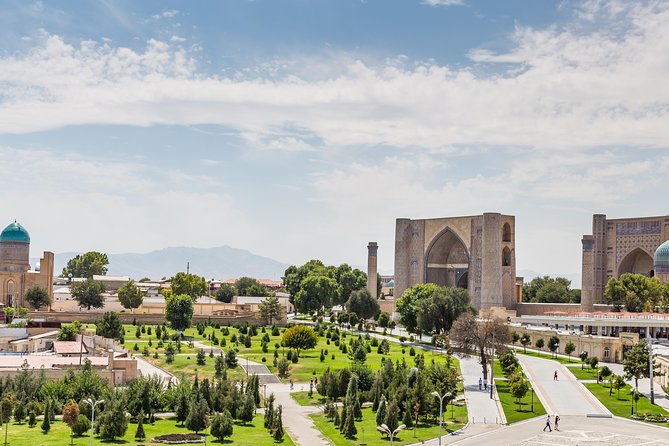
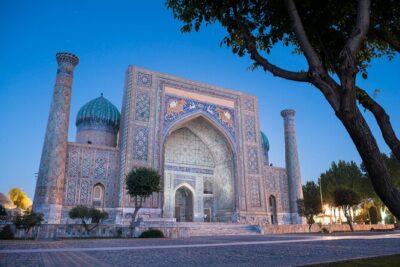
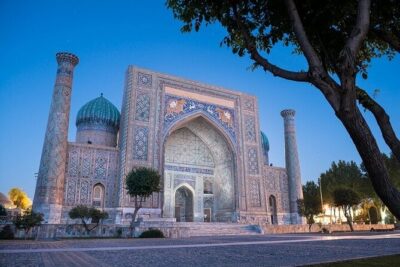
Then comes the Registan, the architectural centerpiece of Samarkand. It served as the heart of the ancient city during the Timurid period. The great square is framed by three madrasas, and even a short visit gives you the basic arrangement that makes the site so memorable.
The schedule identifies the three Registan buildings separately. Sher-Dor Madrasah was built from 1619 to 1636, while Ulugbek Madrasah dates from 1417 to 1420. Tillya Kori Madrasah, completed in 1660, is the final building in the ensemble. Treat the three 30-minute stops as one extended Registan visit, with attention to how the buildings differ in age and decoration.
The Bibi Khanym Mosque follows. In the 15th century, it was among the largest and most magnificent mosques in the Islamic world. The scale is the main point here. Allow your eyes time to take in the structure, even if the formal stop is only half an hour.
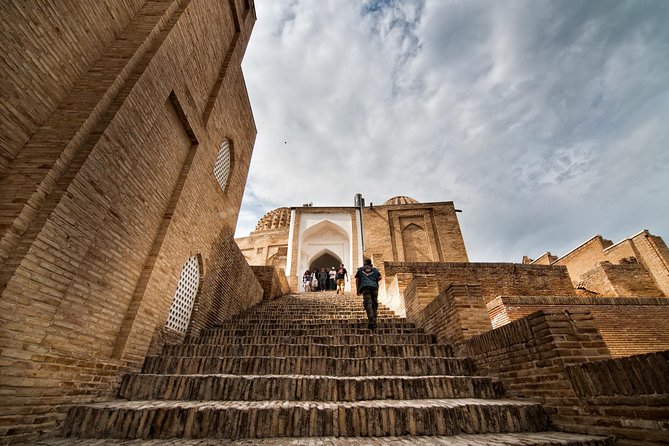
Shah-i-Zinda brings a more intimate sequence of mausoleums. The complex contains tombs from the 14th and 15th centuries, arranged along a passage of richly decorated buildings. The site rewards careful looking, but the 30-minute schedule means you should stay close to your guide and keep an eye on time.
The day ends at Siyob Bozori, Samarkand’s largest traditional bazaar. This is a welcome change from formal monuments. You get a chance to see a working market setting after a morning of imperial architecture, and it is one of the better places in the plan to notice everyday local life.
Samarkand is a strong finale, but the timing can feel especially tight. The city contains enough major sights for a full day on its own, and this route asks you to cover several of them in short visits before returning by train to Tashkent.
Same city, a different kind of day:
- Amirsoy, Chimgan & Charvak Full-Day Adventure
★ 4.9 · 82 reviews - Shymkent Day Tour from Tashkent
★ 4.6 · 71 reviews - Highlights of Tashkent (old and new part)
★ 5.0 · 60 reviews - 2 Days Tour to Bukhara and Samarkand from Tashkent by train
★ 5.0 · 53 reviews
What the $999 price really covers
At $999 per person, this is not a bargain-basement city tour. The value depends on how much planning you want removed from your hands.
The price includes an air-conditioned vehicle, entrance tickets, high-speed train tickets in economy class, three breakfasts, and three lunches. It also covers the three-city rail route: Tashkent to Bukhara, Bukhara to Samarkand, and Samarkand to Tashkent. Those inclusions can add up quickly when arranged separately.
The maximum group size of eight is another important part of the value. A small group makes train transfers and monument visits easier to manage than a large coach tour. It also gives you a better chance to ask questions, though actual group size can vary below the stated maximum.
You still pay for travel insurance and personal expenses. Fees for wearing traditional clothing for photographs or other purposes are also separate. Keep that in mind if you want those photo sessions at historic sites.
The price makes the most sense for a first visit when you have only three days, want major sights covered, and prefer a coordinated schedule. It is less attractive if you already have transport and hotels arranged or if you prefer to spend hours in one city at your own pace.
Pace, guides, and practical comfort
The tour requires a moderate level of physical fitness. You should expect repeated walking at monuments, movement through train stations, and several sightseeing blocks in the same day. The schedule is not designed for a slow, unhurried visit.
The group maximum is eight, and pickup is offered. Public transportation is nearby, but the included vehicle reduces the need to work out local connections between stops. Breakfast and lunch are provided each day, which helps on a schedule where meal breaks may otherwise cut into sightseeing.
Guiding appears to be an important part of the experience. Sevinc is connected with the Samarkand portion, while Outilla is associated with Tashkent. Ibrohim and Izzatullo are names connected with wider arrangements. Guide assignments can vary, so confirm who will meet you in each city if that matters to you.
The operation has also been connected with both very smooth coordination and at least one account of poor organization. That mixed picture is worth taking seriously. Confirm your pickup times, train details, guide contacts, and city-to-city handoffs before departure. The included services have real value, but a fast route leaves little room for confusion.
Free cancellation is available up to 24 hours before the start time for a full refund. Cancellations or changes inside that window are not refunded or accepted. The experience can also be changed or refunded if poor weather affects the trip or if the minimum number of participants is not reached.
Who should book this Uzbekistan tour
I would choose this tour if you have limited time and want the headline sights in all three cities. It is especially suited to first-time visitors who value included transport, fixed train tickets, local guides, and a small group.
It also suits you if Bukhara and Samarkand are priorities but you still want a taste of Tashkent’s museums and public spaces. The route gives you a solid first look without requiring you to coordinate multiple rail journeys and admissions.
I would hesitate if you want long museum visits, relaxed meals, free afternoons, or independent time in the old cities. Three days is enough to see the major places, but not enough to know each city slowly. A moderate fitness level is also important because the days combine transport with repeated walking.
FAQ
How long is the experience?
The experience lasts approximately three days.
Which cities are included?
The route includes Tashkent, Bukhara, and Samarkand.
What train journeys are included?
Economy-class high-speed train tickets are included for Tashkent to Bukhara, Bukhara to Samarkand, and Samarkand to Tashkent.
Are entrance tickets included?
Yes. Entrance tickets for the listed sightseeing stops are included.
Are meals included?
Yes. The price includes three breakfasts and three lunches.
What is the maximum group size?
The maximum group size is eight people.
Is pickup available?
Yes. Pickup is offered.
What fitness level is needed?
A moderate level of physical fitness is required.
What happens if I cancel?
You can cancel at least 24 hours before the experience start time for a full refund. Cancellations made less than 24 hours before the start time are not refunded.
Should you book it?
Book this tour if your goal is to cover Uzbekistan’s three headline cities in a short window with the main transport and admissions handled for you. The combination of high-speed rail, a small group, included meals, and major monuments gives the $999 price a reasonable foundation.
Skip it if you want to settle into one city or explore at a slower pace. For a quick first look at Tashkent, Bukhara, and Samarkand, though, this is an efficient and ambitious route. Just confirm the daily handoffs and accept that you will trade leisure time for breadth.
Just added in Tashkent
- Fergana One Day Tour From Tashkent★ 3.4 · 8 reviews
- Tashkent Chimgan Mountains, Charvak Reservoir and Amirsoy Resort★ 5.0 · 6 reviews
- Ten Bites Adventure Food Tour in Tashkent★ 5.0 · 6 reviews
- Tashkent Private Full-Day City Tour on a Premium Car★ 5.0 · 6 reviews
- Tashkent City Highlights Guided Walking Tour★ 5.0 · 6 reviews
- Amirsoy, Chimgan Mountain & Charvak Lake tour from Tashkent★ 4.5 · 6 reviews
- Samarkand One Day Private Tour from Tashkent with Bullet Train★ 4.5 · 9 reviews
- Day Trip to Amirsoy, Chimgan Mountains & Charvak Lake★ 4.9 · 9 reviews
Tours in Tashkent, compared.
Best of Tashkent Mountains: Amirsoy, Chimgan & Charvak Trip
Read our review →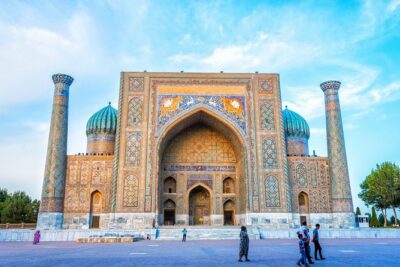
Samarkand One Day Tour – Departure From Tashkent
Read our review →
2 Days Tour to Bukhara and Samarkand from Tashkent by train
Read our review →
Uzbekistan 6 days private tour Tas-Khiva-Buk-Sam-Tas
Read our review →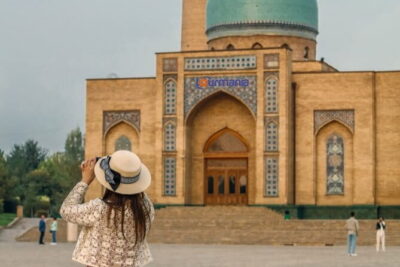
Uzbekistan 8 Days Private Tour Tashkent-Urgench-Bukhara-Samarkand-Tashkent
Read our review →Browse the lists this tour appears in