
Reviewed · TOURS IN TASHKENT
Bukhara One Day Tour – Departure From Tashkent
Bukhara gives you a rare chance to walk through Central Asia’s past in one intense day. You leave Tashkent before breakfast, cross the country by high-speed train, then spend the afternoon among blue-domed madrasas, old trading halls, mosques, and the massive Ark Fortress. The trip is ambitious, but it gets you to the heart of Bukhara without arranging separate train, guide, entrance, lunch, and flight bookings.
I like the private format, since you can move at your own pace instead of following a large group. I also like the smart transport plan: train to Bukhara, flight back to Tashkent, with no need to repeat the four-hour rail journey. The drawback is plain: this is a very long day, usually 12 to 16 hours, and the short visits can make Bukhara feel like a checklist rather than a place to linger.
Key points to know before booking
- Afrosiyob train out, flight back: The morning train leaves Tashkent at 7:30 am and reaches Bukhara at 11:17 am. You return to Tashkent by plane around midnight.
- Thirteen major sights: The route includes Lyabi Khauz, the Kalyan complex, four madrasas, the Ark Fortress, two mausoleums, and more.
- Private guiding: Only your group takes part, so you can ask questions and set the pace within the packed schedule.
- Lunch and entry fees included: You do not need to budget separately for the listed sightseeing admissions or midday meal.
- A physically active day: Expect extensive walking through Bukhara’s historic center, plus early transfers and a late arrival.
- Plan ahead: This experience is often booked about 49 days in advance, so last-minute availability may be limited.
Why this Bukhara day trip works from Tashkent
The biggest strength is the transport design. You are transferred to Tashkent Railway Station at about 6:30 am, board the Afrosiyob high-speed train at 7:30, and reach Bukhara at 11:17. That four-hour journey is not short, but it is far easier than spending the whole day on road transfers, and you can sleep for part of the ride.
At Bukhara station, a guide and driver meet you before taking you toward the Old City. The tour then concentrates on the historic center, where many important sights sit within a manageable area. After lunch and the sightseeing route, you are driven to the airport for the flight back to Tashkent.
I like this arrangement for anyone who has limited time in Uzbekistan. You see what many visitors spread over two or three days, then wake up in Tashkent the next morning. The price is $249 per person, which is not cheap for a day trip, but it covers both long-distance journeys, a private guide, local transport, lunch, and entrance fees. Booking these pieces separately could be awkward, especially when train and flight schedules need to connect.
There is a cost in energy. You leave early, arrive back around midnight, and have little spare time at either airport. One person described the day as stressful because the meeting at Bukhara station was not immediately clear, while others found the operation well organized. Keep your phone available, confirm the meeting details before departure, and allow yourself a little patience during the station and airport changes.
A few more things worth doing in Tashkent
- Samarkand One Day Tour – Departure From Tashkent
★ 5.0 · 313 reviews - All in One Day Tour of Samarkand from Tashkent
★ 5.0 · 34 reviews - From Tashkent: Chimgan Valley Hiking Day Trip
★ 4.9 · 24 reviews
Lyabi Khauz starts the Old City walk
The first major stop is Lyabi Khauz, a historic square built around a large reservoir. Three notable buildings frame it: Kukeldash Madrasah to the north, the khanaka and Nodir Divan-begi complex to the west, and another part of the ensemble to the east.
This is a useful place to begin because it gives you the basic shape of old Bukhara. Rather than seeing one isolated monument after another, you start with a public space that once served as a center of urban life. Allow about an hour here, including the surrounding buildings and explanations from your guide.
The square also helps you get your bearings. Much of the rest of the route unfolds through the old commercial and religious center, so this first stop sets the scene for Bukhara’s role as a place of learning, worship, trade, and government.
Magoki Attori and Chor Minor show two different sides of Bukhara
At the Magoki Attori Mosque, you see an urban mosque built into a residential part of the city. Its position in the center is important. This was not simply a monument placed apart from daily life, but part of the old town’s living fabric. The visit lasts about 30 minutes and includes admission.
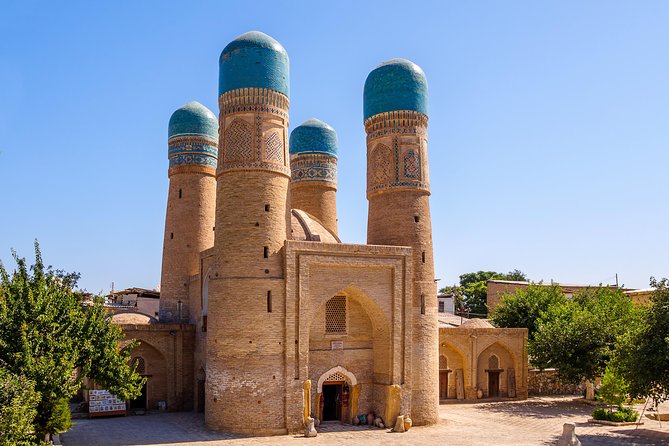
Chor Minor offers a very different visual impression. Its name means four minarets, and the building is easy to recognize because each corner carries a small minaret topped with a blue dome. The four towers are not identical in decoration, which gives the structure a playful quality that differs from the grand, formal facades elsewhere in Bukhara.
Both stops are brief. I would pay close attention to your guide here, since the value comes from understanding how these buildings functioned, not just taking a quick photograph. The private format helps if you want to ask why Chor Minor looks unlike the larger madrasas on the route.
Trading domes reveal Bukhara as a commercial crossroads
The trading domes are among the most practical stops on the tour. This large complex has a hexagonal plan, with shops gathered beneath a broad spherical dome. You may see knives, jewelry, musical instruments, and souvenirs for sale.
You get about 30 minutes here, so this is not a long shopping session. It is better viewed as a glimpse of Bukhara’s old commercial life, with modern selling taking place inside historic spaces. If you want to buy something, keep an eye on the clock. The schedule still has the Kalyan complex and several major monuments ahead.
Shopping can also affect the rhythm of the day. One disappointed account felt too much time went into shops and too little into buildings. Since this is a private tour, you can politely tell your guide if you would rather spend your limited time on architecture and history than browsing merchandise.
Same city, a different kind of day:
- Best of Tashkent Mountains: Amirsoy, Chimgan & Charvak Trip
★ 4.8 · 567 reviews - Tashkent City Tour
★ 5.0 · 121 reviews - Amirsoy, Chimgan & Charvak Full-Day Adventure
★ 4.9 · 82 reviews - Shymkent Day Tour from Tashkent
★ 4.6 · 71 reviews
The Kalyan complex is the visual center of the day
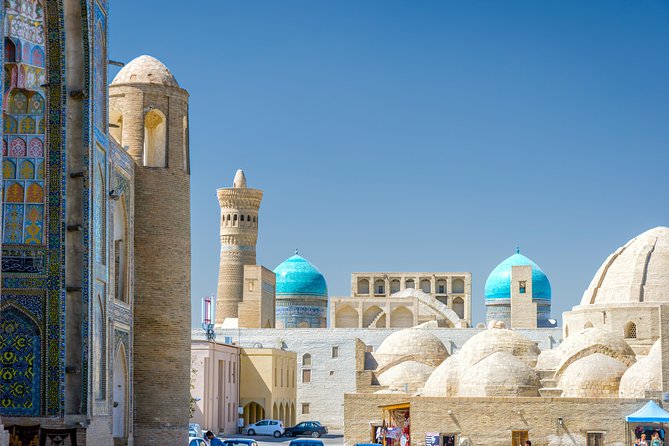
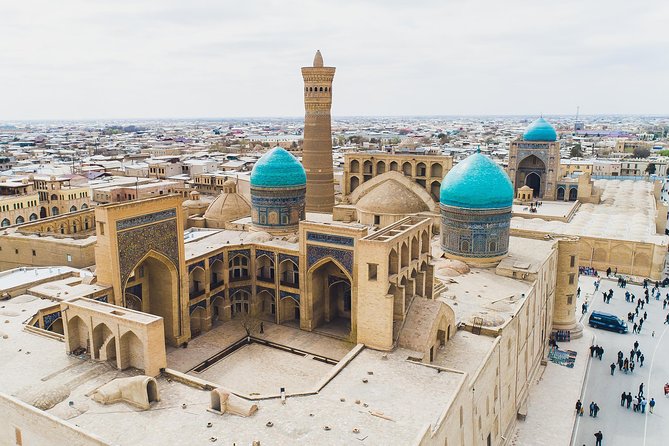
The Kalyan Minaret is one of Bukhara’s defining landmarks. It belongs to the Po-i-Kalyan mosque complex and gives the surrounding square a strong vertical focus. You have roughly 30 minutes at the minaret before moving to the mosque.
The Kalyan Mosque dates to the fifteenth century and is one of the city’s major monuments. Its scale matters. After the smaller Chor Minor and the enclosed trading domes, the mosque gives you a sense of the public and religious power concentrated in Bukhara.
The nearby Mir-i-Arab Madrasa adds another layer. It remains an active religious school where future imams and religious mentors receive their education. You should treat it as a functioning institution, not only as a photo stop. Your guide can explain its place in the city, while you take in the blue domes and formal facade from the areas open to the tour.
These three stops are close enough to form one strong section of the route, but each deserves your attention. The minaret gives height, the mosque gives scale, and the madrasa gives living religious context. The 30-minute timing at each site is efficient, though not generous.
Ulugbek and Abdulaziz-Khan show the range of madrasa design
Ulugbek Madrasah was built in 1417 by the architects Ismail Isfagani and Najmeddin Bukhari. For many years, its design influenced Islamic schools in other Central Asian cities. The building uses balanced proportions and restrained decoration, yet it still feels impressive.
That restraint is worth noticing. Not every important building in Bukhara depends on dense surface decoration. Here, the shape and relationship of the parts do much of the work. I would listen for the guide’s explanation of how the courtyard, entrances, and teaching spaces fit together.
Abdulaziz-Khan Madrasah dates from 1651 to 1652 and is considered the last large madrasa built in Bukhara. Its layout follows the familiar four-ayvan plan, but the arrangement of rooms and domed sections is more unusual. These two madrasas work well as a pair because you can compare an earlier, measured design with a later and more elaborate approach.
Again, the timing is about 30 minutes at each. You will get a strong introduction, but not a slow architectural study. If you enjoy details, take notes during the explanations because the number of monuments can blur together by late afternoon.
The Ark Fortress puts Bukhara’s rulers in view
The Ark is the old citadel and residence of Bukhara’s khans. Excavations indicate that a citadel occupied this site from as early as the fourth century BC. Through repeated construction and destruction, the mound grew into an artificial hill about 20 meters high, with its upper parts built during the time of the final Bukharan emirs.
This is one of the stops that gives the day political weight. The mosques and madrasas show religious and educational life, while the Ark points to the rulers who controlled the city. Its raised position also helps you understand why a fortified residence was placed here.
You have 30 minutes, so do not expect to see every corner. Use the visit to focus on the citadel’s unusual form and long span of use. The Ark is not simply a single palace from one period. It is a layered site shaped by centuries of rebuilding.
Bolo Haouz Mosque adds a quieter historical note
Across from the Ark, in the Registan district, is Bolo Haouz Mosque. It was built in 1712 and is included within Bukhara’s UNESCO-listed historic area.
Placed after the Ark, it provides a useful contrast. The citadel represents authority and defense, while the mosque returns you to worship and community life. The stop lasts about 30 minutes, enough for an explanation and a close look without taking too much time from the final monuments.
By this point, fatigue may be the real issue. You have been moving since early morning, and the heat or uneven walking surfaces can make the afternoon feel longer. Wear comfortable shoes and keep water with you, even though a moderate level of physical fitness is all the tour formally requires.
Two mausoleums finish the historical route
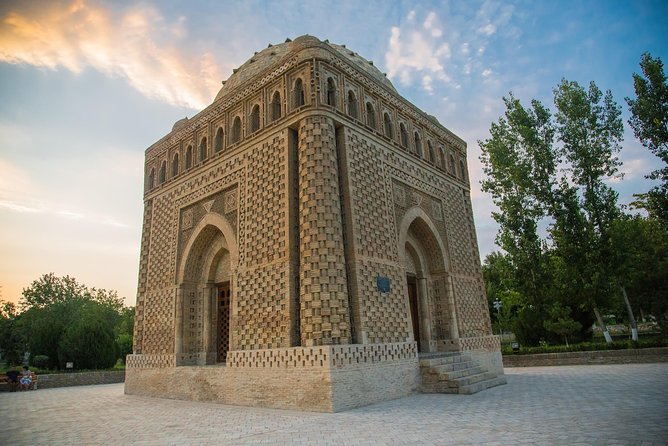
The Ismail Samani Mausoleum is one of the most important early Islamic buildings in Central Asian architecture. Built in the tenth century, it sits just northwest of Bukhara’s historic center and is regarded as the oldest funerary building of its kind in the region.
Its age makes it an especially valuable final stop. After a day of grand facades and active religious buildings, this mausoleum brings you back to an earlier architectural period. You can expect about 30 minutes here, including the walk and guide’s explanation.
The Chashma Ayub Mausoleum includes both a religious building and a holy spring. It was first built by order of Karakhanid rulers in the twelfth century and rebuilt several times between the fourteenth and nineteenth centuries. During the reign of Tamerlane, the structure was completed.
Today, the site includes a Museum of Water. That detail makes it different from the other monuments. You are not only seeing a mausoleum, but also a place tied to water, belief, and the practical needs of the city. It is a fitting last stop before the return to the airport.
Lunch, transport, and the real value of $249
Lunch is included, which matters on a schedule this tight. You do not have to stop and search for a restaurant while trying to fit in thirteen sights, and the meal gives you a needed pause before the second half of the route.
The transport package is the main reason the price can make sense. You receive economy-class train tickets from Tashkent to Bukhara, an economy flight from Bukhara to Tashkent, all listed entrance fees, local transport, lunch, and private guiding. Travel insurance and personal spending are separate.
The 4.6 rating from 37 evaluations and 92 percent recommendation figure suggest that the format works well for many people, but the weaker experiences point to the risks. Transport coordination must be clear, and a missed flight or unavailable seat can disrupt the entire day. On rare occasions, the Afrosiyob train is replaced by the most comfortable class of regular train. One booking reportedly failed when no return-flight seat was available, so confirm the transport arrangements before setting out.
Who should book this Bukhara experience?
I would choose this tour if you have only one free day from Tashkent and want to see Bukhara’s headline sights without planning a complicated chain of bookings. It also suits you if you prefer a private guide, want lunch and admissions handled, and accept that the day will be demanding.
I would not choose it if you want slow mornings, long museum visits, relaxed shopping, or several evenings in Bukhara. The route is packed, and some stops receive only 30 minutes. A longer stay would let you return to favorite squares, spend more time at the trading domes, and experience the city after the day’s sightseeing pace has ended.
The most praised parts are the well-organized train and flight combination, the private guide, and the friendliness of the guide and driver. One particularly positive account described the tour as memorable and praised the guide’s helpful attitude. Another found the explanation clear and the day educational. Those strengths matter, but they depend on good meeting instructions and transport availability.
Book at least several weeks ahead if your dates are fixed. The experience is often reserved about 49 days in advance, and the early start means you should stay somewhere with an easy morning transfer to the railway station. Free cancellation is available up to 24 hours before the start time. Poor weather or failure to meet the minimum number of participants can lead to a date change or full refund.
FAQ
How long does the Bukhara day tour take?
The experience lasts about 12 to 16 hours. You leave Tashkent early in the morning and return around midnight after the evening flight from Bukhara.
What time does the tour start?
The stated start time is 7:00 am. Transfer to Tashkent Railway Station takes place at about 6:30 am, and the Afrosiyob train leaves at 7:30 am.
How long is the train ride to Bukhara?
The Afrosiyob high-speed train takes about four hours. The scheduled arrival in Bukhara is 11:17 am.
How do you return to Tashkent?
You return by economy-class flight from Bukhara to Tashkent. After arriving at the Tashkent airport, a transfer takes you to your hotel or home.
Are train and flight tickets included?
Yes. The package includes an economy-class train ticket from Tashkent to Bukhara and an economy-class flight ticket from Bukhara to Tashkent.
Is lunch included?
Yes, lunch is included. Personal expenses and travel insurance are not included.
Is this a private tour?
Yes. Only your group participates, and the tour is led by a private guide with local transport provided.
How many sights are included?
The planned route includes 13 stops, including Lyabi Khauz, Magoki Attori Mosque, Chor Minor, the trading domes, the Kalyan complex, four madrasas, the Ark, Bolo Haouz Mosque, and two mausoleums.
Can I cancel for a full refund?
You can cancel at least 24 hours before the experience start time for a full refund. Changes or cancellations made less than 24 hours ahead are not accepted for a refund.
Just added in Tashkent
- Fergana One Day Tour From Tashkent★ 3.4 · 8 reviews
- Tashkent Chimgan Mountains, Charvak Reservoir and Amirsoy Resort★ 5.0 · 6 reviews
- Ten Bites Adventure Food Tour in Tashkent★ 5.0 · 6 reviews
- Tashkent Private Full-Day City Tour on a Premium Car★ 5.0 · 6 reviews
- Tashkent City Highlights Guided Walking Tour★ 5.0 · 6 reviews
- Discover Uzbekistan – explore top destinations: Samarkand, Bukhara & Tashkent★ 4.5 · 6 reviews
- Legends and Crafts: Suzani Masterclass & Cultural Immersion★ 5.0 · 11 reviews
- Plov and Samsa Cooking Class in Tashkent★ 4.3 · 6 reviews
Tours in Tashkent, compared.
Best of Tashkent Mountains: Amirsoy, Chimgan & Charvak Trip
Read our review →
Samarkand One Day Tour – Departure From Tashkent
Read our review →
2 Days Tour to Bukhara and Samarkand from Tashkent by train
Read our review →
Uzbekistan 6 days private tour Tas-Khiva-Buk-Sam-Tas
Read our review →
Uzbekistan 8 Days Private Tour Tashkent-Urgench-Bukhara-Samarkand-Tashkent
Read our review →Browse the lists this tour appears in