
Reviewed · FERGANA VALLEY TOURS
Fergana Valley 2-Day Private Tour
The most rewarding part of this two-day trip is its focus on working traditions rather than only famous monuments. You move from Kokand’s tiled palace and mosque to Rishtan’s blue ceramics, then on to Margilan, where natural silk is dyed and made by hand. The result feels like a useful extension of Uzbekistan’s better-known Silk Road cities.
I like the private format, which keeps the pace suited to your group of up to three. I also like the route itself: it begins with grand architecture, then shifts toward crafts, agriculture, old city ruins, and ordinary local life. The main drawback is time spent on the road. The listed sightseeing adds up to only about six hours, with the rest of the two days used for transport.
Key points at a glance
- Kokand opens the tour with major monuments: Khan Palace and the 19th-century Jami Mosque give you the strongest architectural sights.
- Rishtan is the hands-on craft stop: You can see the Fergana Valley’s famous blue pottery tradition in local workshops.
- Margilan focuses on natural silk: Allow two hours for fabric dyeing and traditional handicraft production.
- Kuva adds an archaeological pause: Ancient walls, a citadel site, and excavated remains show the valley’s Silk Road importance.
- The route runs one way: Pickup is in Kokand, and the tour ends at Margilan train station, which can be useful for onward travel.
- The price works best for a small group: At $250 per group of up to three, transport and a private local guide are included, but meals, lodging, and entry tickets are not.
Why the Fergana Valley deserves two days
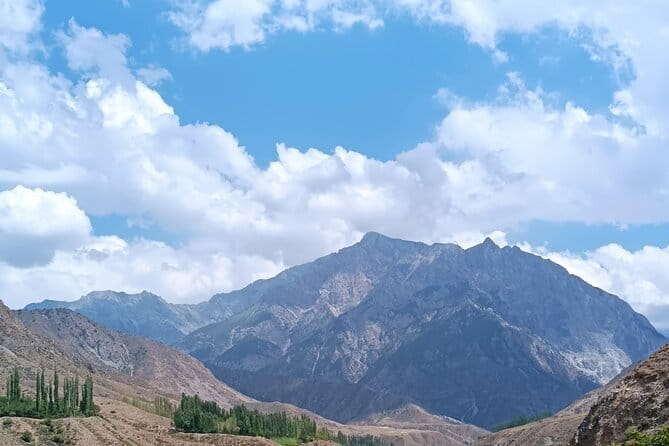
Samarkand and Bukhara receive most of the attention in Uzbekistan, but the Fergana Valley gives you a different view of the country. Here, the emphasis is less on monumental blue-tiled squares and more on crafts, food, clothing, farming, and daily work.
That difference matters. The valley is not simply another collection of old buildings. It helps explain how Silk Road culture continued through skilled local trades. Pottery and silk are not presented as museum pieces only. They remain part of the region’s identity and production.
This tour is especially useful if you have already seen Uzbekistan’s headline cities and want more contact with smaller places. It also works well if you want an introduction to the valley without arranging several separate taxis, guides, and workshops yourself.
The route is private, and only your party takes part. Sardorbek is named as the experience provider, and the tour includes local guiding and transport. Since the vehicle and guide are arranged for your group, you avoid the fixed pace of a large coach tour.
Other craft-town trips from Uzbekistan:
- Fergana – Golden Valley From Tashkent 1 night / 2 days
★ 4.5 · 41 reviews - Fergana Valley Tour
★ 4.0 · 17 reviews - Fergana One Day Tour From Tashkent
★ 3.4 · 8 reviews
Day one: Kokand’s palace and mosque
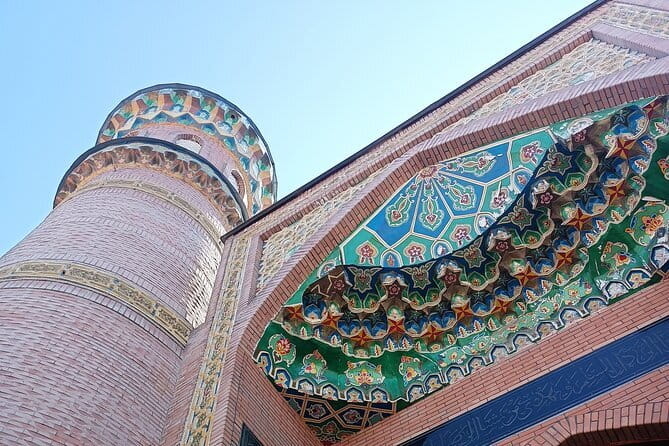
Your first day begins in Kokand, with a visit to Khan Palace. The approach through the park gives you a gradual introduction before the palace comes into view. The building is known for its elaborate use of mosaic and majolica, with decoration covering the exterior in many colors.
Allow about one hour here. This is the tour’s most decorative architectural stop, so it deserves a slower look than a quick photograph. Pay attention to the work of the craftsmen: the appeal is not just the size of the palace, but the repeated tiles, bright surfaces, and careful patterns.
The admission fee is not included. You should also note that the published meeting point is at AvgoMoyka Tango in Kokand, so confirm the exact pickup details with the provider before setting out. The tour offers pickup, but the supplied information does not specify every possible pickup location.
Khan Palace provides a strong start, but it is also where expectations should be clear. This is a sightseeing visit, not a long historical lecture or a full-day palace study. You receive about an hour here before moving to the next part of Kokand.
Jami Mosque and its 98 columns
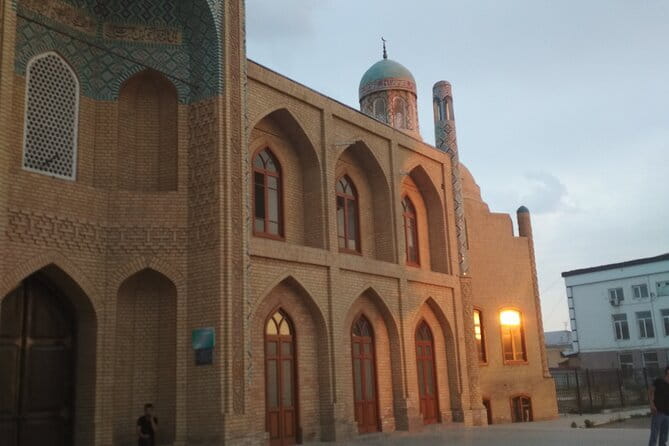
The second stop is Kokand’s Jami Mosque, one of the city’s major 19th-century buildings. Its central feature is a forest of 98 sharply shaped columns, a large undertaking for the local craftsmen who built it.
You have about 50 minutes at the mosque. That is enough to take in the scale and architectural solutions, though anyone interested in religious buildings may wish for more time. The mosque is located in the core of Kokand, so this visit also gives you a feel for the city center rather than keeping you only inside a palace complex.
Admission is not included here either. Dress and behavior should be respectful at a place of worship, even though the tour details do not spell out a clothing policy. Your guide can help with local expectations.
Together, Khan Palace and Jami Mosque give day one a clear architectural shape. The palace is covered in surface decoration, while the mosque impresses through repeated columns and structural scale. They are different kinds of beauty, and seeing both helps prevent Kokand from becoming a one-sight stop.
Rishtan’s blue pottery workshops
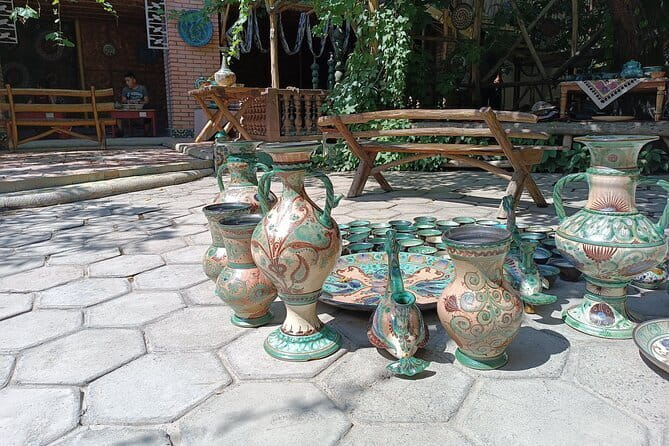
Rishtan changes the mood completely. The town has been associated with pottery production for more than 900 years, and the visit focuses on workshops making practical objects used in everyday life.
You might see bright blue pieces such as lyagans for pilaf, soup bowls, tea cups, and kuza jugs. These are not merely ornamental souvenirs. Their forms connect the craft to the table, the kitchen, and local customs.
The scheduled visit lasts one hour, and admission is free. That makes Rishtan one of the better-value stops on the route, especially if you enjoy seeing how a regional craft is kept alive through working production.
The exact workshop process is not detailed, so you should not assume that a full demonstration or hands-on activity is guaranteed. What you can expect is a visit connected to local ceramic production, with the chance to see the distinctive bright, blue style associated with Rishtan.
For me, this is one of the trip’s most useful stops because it adds context to the decorated buildings seen earlier. You are no longer only looking at finished architectural surfaces. You are seeing the kind of skilled ceramic tradition that helps define the valley.
A few more things worth doing in Uzbekistan
- 2 Days Tour to Bukhara and Samarkand from Tashkent by train
★ 5.0 · 53 reviews - Yurt stay and Hiking in the Nurata Mountains tour – 2 days
★ 5.0 · 35 reviews - Aral Sea Adventures (2 day)
★ 5.0 · 30 reviews - From Khiva To Aral Sea 2-Days One Night In Yurt Stay
★ 4.6 · 20 reviews
Day two: Fergana and the memory of Ahmad al-Fergani
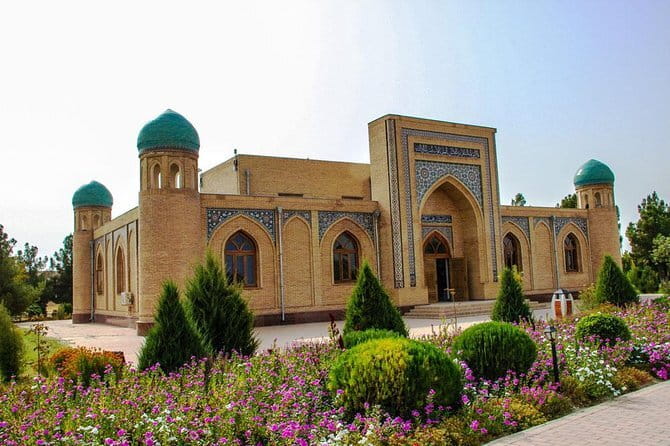
The second day begins in Fergana, where a monument honors Ahmad al-Fergani, a 9th-century astronomer and mathematician associated with the city. The visit lasts about 50 minutes and is free of charge.
The monument is the main named point of interest, but the surrounding architecture also deserves attention. The city contains examples of Russian-period colonial architecture, offering a visual change from Kokand’s palace decoration and mosque columns.
This is a short orientation stop rather than an extensive city tour. You will have time to see the monument and note the older architectural character of the area, but the route does not promise a broad survey of Fergana.
That limited time may suit you if Fergana is part of a larger valley route. If you want long walks, museums, or a detailed study of the city, this tour may feel brief. Its purpose is to connect several important places in two days, not to examine each city at length.
Kuva’s ruined citadel and Silk Road past
Kuva is the most archaeological stop. In the old part of the city, a hill marks the area where a citadel and shakhristan, the central part of an old city, once existed.
The visit lasts about 40 minutes and is free. You will see ruins and excavated remains that point to Kuva’s earlier importance on the Silk Road. The settlement eventually failed to withstand the Mongol invasion, leaving the remains as a reminder of how exposed major trade centers could be.
Do not expect a fully restored monument. Kuva is valuable because of its fragments, earthworks, and sense of former scale. It requires a little imagination, and your guide’s explanation will matter more here than at a brightly decorated palace.
The short schedule is reasonable for an archaeological site with limited visible remains. Still, if ancient ruins are your main interest, you may wish the tour allowed more time. For most people, Kuva works best as a compact historical pause between Fergana and Margilan.
Margilan and the making of natural silk
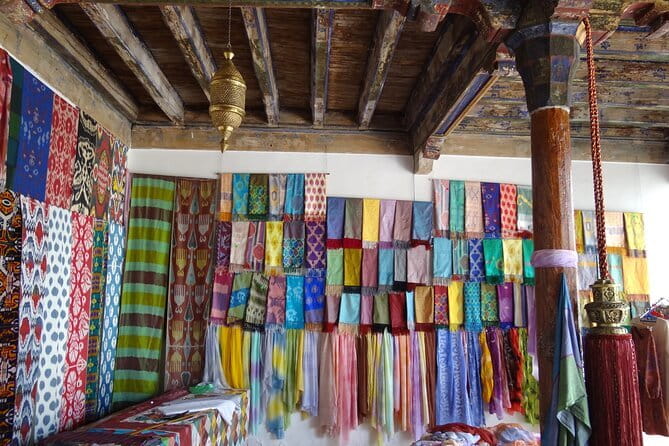
Margilan receives the longest visit, about two hours, and for good reason. The city is known for natural silk production, including the dyeing of fabric with natural colors and the continuation of traditional handicraft work.
This is the tour’s clearest look at a living production tradition. You can expect to see fabric being colored in a wide range of tones and to learn how the work connects raw material, dye, pattern, and finished cloth.
The information provided does not name a particular factory or guarantee a purchase opportunity, so treat the stop as a production visit rather than a shopping promise. Admission is free, but you should budget separately if you decide to buy silk goods.
Two hours gives Margilan more breathing room than the other stops. You can look closely at the fabric and process instead of rushing through in the same way you might at a monument. If you want meaningful craft encounters, this is likely to be the high point of the second day.
The route ends at Uzun Xovuz in Margilan, with the stated endpoint at Margilan train station. That arrangement is practical if you plan to continue by rail, but it also means you should plan your next connection carefully. The tour does not include accommodation or onward travel.
What the $250 group price really covers
The price is $250 per group of up to three people, not $250 per person. For two or three people, that can be a sensible way to cover a wide area, since local transport and a private guide are included.
The value depends on how you use the tour. You are paying for the convenience of a planned route through Kokand, Rishtan, Fergana, Kuva, and Margilan, plus a private vehicle and guide. You are not paying for meals, lodging, or entrance tickets, so add those costs before comparing it with a larger group excursion.
For a solo visitor, the total is less attractive than for a small party. For three people, the effective cost is about $83 per person before extras, which makes the private arrangement easier to justify.
The long driving periods are important to the value calculation. The sightseeing time listed for the six stops is limited, and the rest of the two days goes toward transportation. You should book this tour for the route and access it provides, not because it offers two full days at each destination.
Practical details before you book
The tour is offered with pickup and a mobile ticket. Confirmation is normally received at booking, unless you reserve within two hours of departure. Last-minute bookings are confirmed as soon as possible, subject to availability.
Most people can participate, and service animals are allowed. The route is near public transportation, but the supplied information does not give detailed accessibility notes for each monument, workshop, or archaeological site. If you have mobility concerns, ask specifically about the walking surfaces and vehicle arrangements before booking.
Food is not included, so plan to pay separately during the two days. Accommodation is also excluded. The experience is designed as a private sightseeing transfer between valley cities, not as a package with overnight lodging.
The cancellation rule is firm. You receive a full refund only if you cancel at least three full days before the local start time. Within that period, the payment is not refunded, and late changes are not accepted.
Who will get the most from this route
I would choose this tour if you want to see more than Uzbekistan’s famous historic centers and care about local production. Pottery in Rishtan and silk in Margilan give the route its strongest character.
It also suits a small group that values privacy and direct transport. You can avoid piecing together separate arrangements between several cities, and the one-way finish at Margilan may fit a wider trip through the valley.
I would be more cautious if your priority is relaxed sightseeing. Six stops across two days means movement is part of the experience. You should also think twice if you want extensive museum time, long city walks, or a detailed archaeological visit.
The trip is a good match for:
- Small groups of up to three people
- Visitors interested in pottery, silk, and traditional crafts
- People who want a private guide and transport
- Those connecting onward from Margilan train station
- Repeat visitors to Uzbekistan seeking a different regional experience
Should you book the Fergana Valley tour?
Book it if you want a practical introduction to the valley’s crafts and historic towns, and if you are comfortable spending a good part of the two days in transit. The strongest moments are likely to be Rishtan’s ceramics and Margilan’s natural silk, supported by Kokand’s palace and mosque.
Before paying, confirm the pickup point, the exact entrance fees, and how the transport schedule fits your onward plans. If three people share the $250 price, the value is solid. If you are alone and prefer slow exploration, arranging fewer stops over more days may suit you better.
FAQ
How long is the Fergana Valley private tour?
The experience lasts approximately two days. The listed sightseeing time covers the stops, while the remaining time is used for transportation between destinations.
How many people can join the private tour?
The price covers one private group of up to three people. Only your group participates.
What is included in the price?
A local guide’s private tour and transport are included. Pickup is offered, and the experience provides a mobile ticket.
Are meals included?
No. Food is not included in the tour price.
Is accommodation included?
No. You must arrange and pay for accommodation separately.
Are entrance tickets included?
No. Entrance tickets are not included. Khan Palace and Jami Mosque specifically list admission as extra, while Rishtan, Fergana, Kuva, and Margilan list free admission.
Where does the tour start and end?
The stated starting point is AvgoMoyka Tango in Kokand. The stated endpoint is Margilan train station in Margilan.
What places are visited during the two days?
The route includes Khan Palace, Jami Mosque, and Rishtan on the first day. The second day includes Fergana, Kuva, and Margilan.
What is the cancellation policy?
You can receive a full refund if you cancel at least three full days before the experience start time. Cancellations or changes made within three full days are not refunded or accepted.
Just added in Uzbekistan
- Fergana One Day Tour From Tashkent★ 3.4 · 8 reviews
- Khiva Walking Tour★ 4.7 · 22 reviews
- Khiva: Historical City Highlights Guided Walking Tour★ 4.8 · 156 reviews
- Samarkan City Tour From Tashkent★ 4.3 · 5 reviews
- Ten Bites Adventure Food Tour in Tashkent★ 5.0 · 6 reviews
- Discover Uzbekistan – explore top destinations: Samarkand, Bukhara & Tashkent★ 4.5 · 6 reviews
- Tashkent Chimgan Mountains, Charvak Reservoir and Amirsoy Resort★ 5.0 · 6 reviews
- Tashkent Private Full-Day City Tour on a Premium Car★ 5.0 · 6 reviews
Fergana Valley Tours, compared.

Browse the lists this tour appears in