
Reviewed · WALKING TOURS
Bukhara Walking Tour
Bukhara reveals itself one courtyard, dome, and carved brick wall at a time. This private walking tour connects the city’s major sights in about five to six hours, from the shaded Lyab-i-Hauz pool to the Samanid Mausoleum. Along the way, you get old mosques, grand madrasas, the Ark Citadel, and even a small look at Central Asian puppet theater.
I like the route for two clear reasons. First, it covers the big sights without reducing Bukhara to a quick photo stop. Second, the guides, including Peri and Nilufar, bring strong local knowledge and fluent English, with Spanish, French, German, and Russian also available. The short puppet show is an especially welcome change of pace.
The main catch is cost control. The $28 price covers the guide and taxes, but monument admission, lunch, transport, and personal expenses are extra. You also spend much of the day on foot, so this suits you best if you enjoy walking and want a full historical route rather than a light introduction.
Key points at a glance
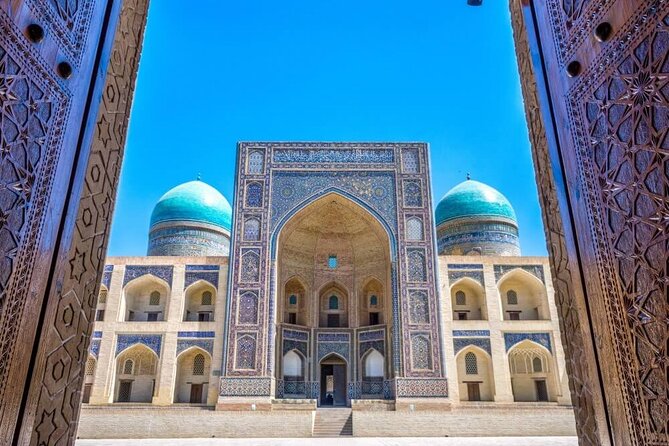
- A full old-city route: See Lyab-i-Hauz, the trading domes, Poi Kalyan, the Ark, Bolo Hauz, and three major mausoleums or religious sites.
- A private experience: Only your group participates, giving you more room to ask questions and request a slower or faster pace.
- A rare puppet-theater stop: Learn about Central Asian puppets and watch a two-minute demonstration by the master.
- Strong guide choice: Peri and Nilufar are specifically praised for patience, energy, clear English, and detailed explanations.
- A useful price comparison: The $28 fee is reasonable for a half-day private guide, but you must budget separately for entrance tickets and food.
- A one-way finish: The walk starts at Lyab-i-Hauz and ends at the Samanid Mausoleum, so you finish near one of Bukhara’s oldest monuments rather than returning to the start.
Why this Bukhara walk works so well
Bukhara is easier to understand on foot than from a vehicle. Its central sights sit close enough together for a walking route, but each quarter has a different feel and purpose. You move from a social meeting place to religious schools, trade buildings, royal defenses, neighborhood mosques, and early Islamic funerary architecture.
The route also gives you a useful time frame. Five to six hours is long enough for context, but not so long that the day becomes an endless parade of buildings. The schedule allows about an hour at Lyab-i-Hauz, an hour at Poi Kalyan, and forty minutes at the Ark, with shorter stops between them.
Because this is private, you can ask a guide to pause over details that interest you. If you care about architecture, the madrasa portals deserve attention. If you prefer city stories, the Ark and the old Jewish quarter offer more human context. The tour does not force you into a large group moving at one fixed speed.
More Walking Tours in Bukhara
- All You Need To Know About Bukhara. A Walk In The Town
★ 4.9 · 31 reviews - Bukhara Historical City Highlights Guided Walking Tour
★ 4.5 · 16 reviews - Bukhara: Private Guided Walking Tour with Hotel Pickup
★ 5.0 · 11 reviews
Starting beside the Lyab-i-Hauz pool
The tour begins at the Lyab-i-Hauz ensemble, the traditional center of Bukhara’s social life. The name refers to the pool at the heart of the complex, where the setting becomes especially active in the evening.
You see three important buildings here:
- Kukeldash Madrasah
- Nadir Divanbegi Madrasah
- The khanaka, a lodging place for dervishes
This is a strong opening because it gives you several types of building in one compact area. A madrasah served as a place of Islamic learning, while a khanaka offered lodging for dervishes. Your guide can help you read the complex as more than a collection of decorated facades.
The hour planned here gives you time to get oriented. You can study the relationship between the pool, the buildings, and the surrounding public space before moving into the tighter streets of the old city.
A small puppet theater with a two-minute show
The puppet-theater stop is one of the tour’s most unusual features. It is described as the only place in Uzbekistan where you can learn about the history of Central Asian puppets and puppet theater.
You can watch a two-minute show by the master, and if luck is on your side, you may find a puppet to examine or purchase. The stop lasts about twenty minutes, so it will not take over the day. That is just right. It gives your eyes and feet a break while adding a cultural subject you would be unlikely to encounter in a standard monument route.
I especially like this inclusion because it keeps the tour from becoming a checklist of mosques and madrasas. Bukhara’s culture is not only carved brick, tiled portals, and religious schools. A short performance offers a glimpse of another local tradition.
The details here are somewhat dependent on what is available at the time of your visit. The show is short, and the chance to find a puppet is not guaranteed.
Magoki Attori Mosque and the old trading domes
The Magoki Attori Mosque is presented as the first mosque in Bukhara and the whole of Uzbekistan. Before Islam, the site was used by pagans who sold idols. That layered use makes the building important even if your visit inside is brief.
The stop also connects with a carpet museum. Admission is not included, so you should expect to pay separately if you want to enter the relevant sites. The listed stop lasts about fifteen minutes, which suggests a focused explanation rather than a long museum visit.
From here, the route reaches Bukhara’s trading domes. The city once organized much of its commercial life under these covered structures, and three domes remain part of the walking route. Their value is practical as well as visual: they help you picture how merchants, craftspeople, and shoppers used the old city.
The route also includes the Jewish quarter. The information provided does not promise a separate museum or synagogue visit, so think of this as a chance to see part of the historic urban fabric and hear about the community from your guide.
More walks around Bukhara:
- Bukhara: Walking Tour with a Small Group
★ 5.0 · 10 reviews - A Group Walking Tour Of Old Town
★ 5.0 · 8 reviews - Samarkand: Historical Monuments Guided Walking Tour
★ 4.8 · 446 reviews - Khiva: Historical City Highlights Guided Walking Tour
★ 4.8 · 156 reviews
Ulughbek and Abdulaziz-Khan madrasas
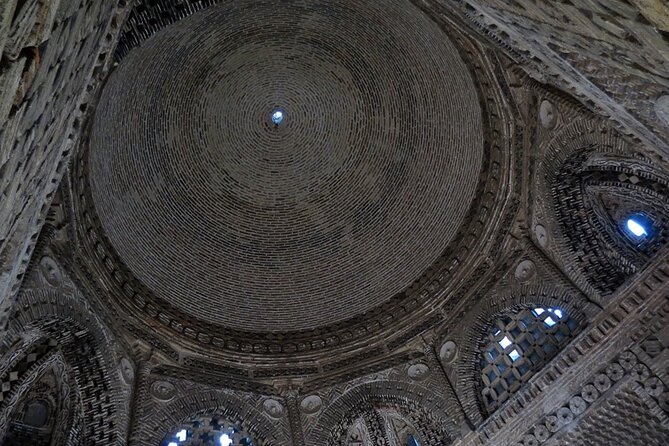
The Ulughbek Madrasah is described as Bukhara’s oldest madrasa and the only Timurid-period monument in the city. It receives about fifteen minutes, enough for your guide to point out its place in Bukhara’s architectural story.
The Timurid connection matters because Bukhara is often associated with later religious and commercial buildings. This stop gives you an earlier dynastic layer. You do not need to be an architecture specialist to appreciate the contrast between a plain historical explanation and the actual age of the structure.
The Abdulaziz-Khan Madrasah follows. It is described as the most magnificent madrasa in Bukhara and the first monument in the city to use yellow decoration. That color detail gives you something specific to look for rather than a vague instruction to admire the design.
Both stops are short. If you want long time inside every building, this tour may feel brisk. If you want a broad introduction to the city’s major monuments, the timing keeps the walk moving.
Poi Kalyan, Bukhara’s great architectural pause
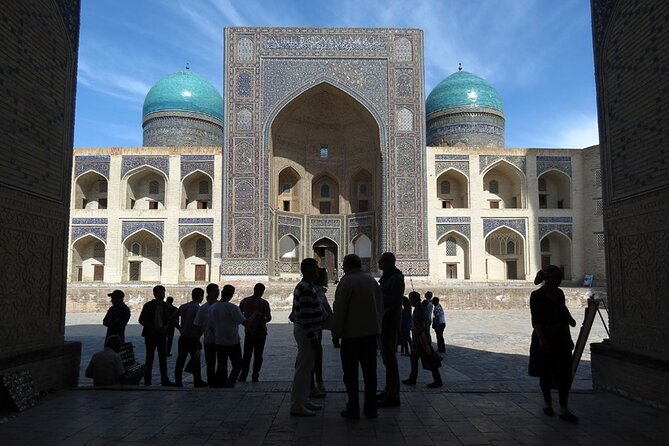
Poi Kalyan is the visual center of the route and gets about an hour. The complex contains three major monuments:
- The Kalyan Minaret
- The Kalyan Mosque
- The Miri Arab Madrasah
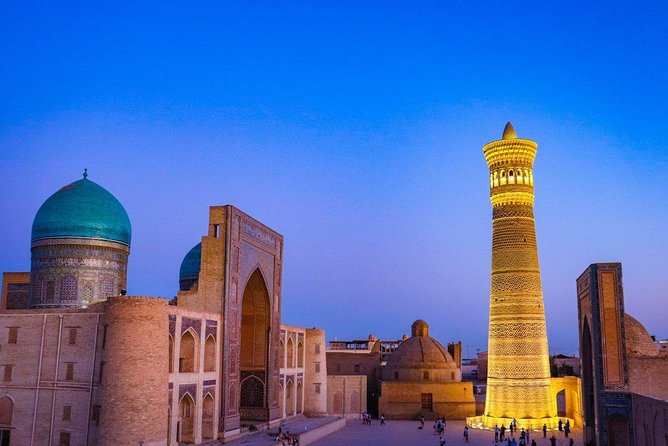
The Kalyan Minaret is a pre-Mongol monument and the highest minaret in the city. Its survival gives the complex a strong sense of age, but the key point for you is scale. This is the kind of sight that needs time to absorb from different angles, not just a quick photograph.
The Kalyan Mosque is described as the largest medieval mosque in the city. That makes it one of the tour’s essential stops, and the hour at Poi Kalyan gives your guide room to explain how the three buildings relate to each other.
Miri Arab is still a madrasa for male students. The active religious role is important. You are not looking only at a preserved monument with no present-day connection. At the same time, access to particular interiors or areas can depend on current rules, and entrance fees are not part of the tour price.
Poi Kalyan is also the point where the tour may feel most crowded or visually busy, especially compared with quieter lanes. The private format helps because you are not tied to a large group’s pace.
The Ark Citadel and Bolo Hauz Mosque
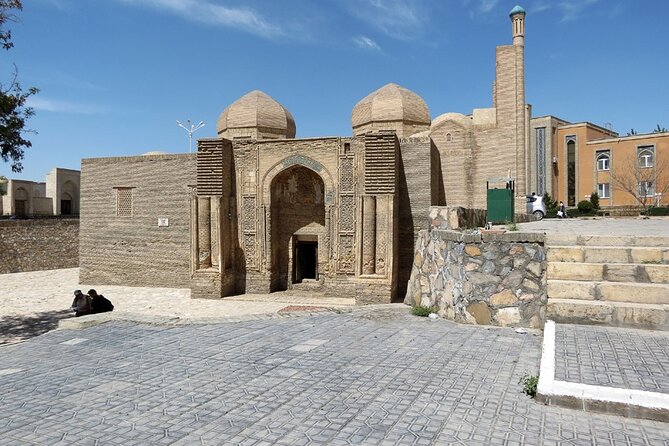
The Ark takes you from religious and commercial Bukhara into the world of political power. It was the winter residence of the Bukhara emirs and was considered a city within the city.
The forty-minute visit gives you a practical sense of the Ark’s role. It was not merely a palace facade. It was a separate fortified world connected to the emir’s government and daily life. Your guide’s explanation is especially useful here because the scale of the site can be hard to grasp without context.
After the Ark, the route continues to Bolo Hauz Mosque. This mosque has the city’s highest columns and is also called Chilustun, or forty columns. The building itself has twenty columns, but the reflection in the reservoir creates the impression of forty.
That detail is exactly the kind of small fact that improves a walking tour. You look at the mosque, then look again at the water and understand the name. The planned stop lasts about twenty minutes, so bring your attention to the columns and reflection rather than expecting a long visit.
Chashmai Ayub and the water-supply museum
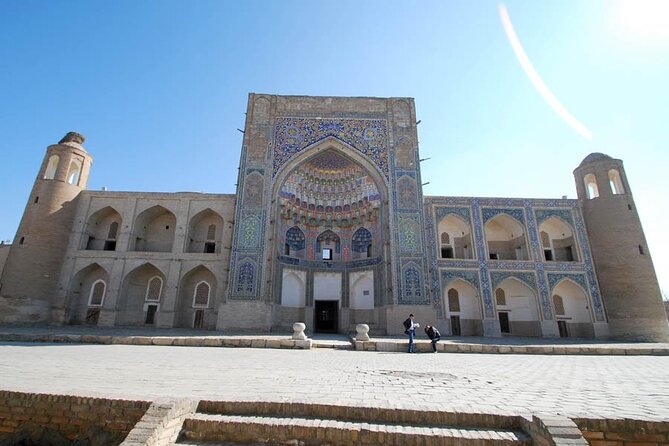
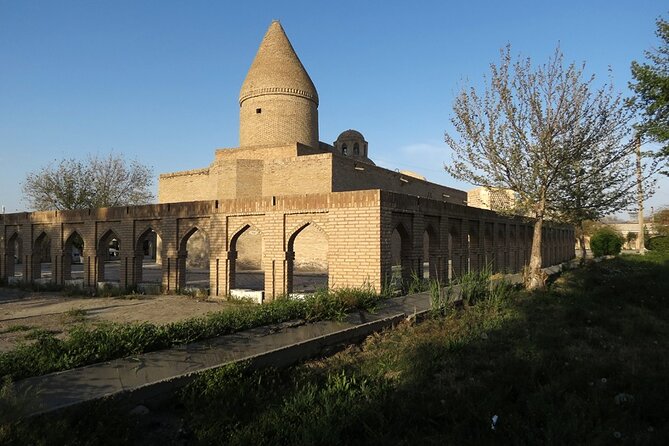
Chashmai Ayub Mausoleum serves two roles. It is a mausoleum associated with Saint Job, and it houses Bukhara’s water-supply museum.
This stop adds an everyday subject to the route. Mosques, madrasas, and citadels show religion and power, but water explains how the city functioned. A museum about water supply can make Bukhara’s dry setting and old urban systems easier to understand.
The visit is scheduled for about twenty minutes. As with the other monuments, admission is not included. The stop is short enough to fit comfortably into the walking day, but worthwhile if you want more than decorative architecture.
Ending at the Samanid Mausoleum
The tour ends at the Ismail Samanid Mausoleum, with about thirty minutes planned here. This is a fitting final stop because the building is described as the first mausoleum in Central Asia and the second in the Islamic world.
It is also associated with the founder of the first local empire in Central Asia. The pre-Mongol structure gives the tour a strong closing point, bringing you back to an early period after the later madrasas, royal buildings, and active mosque complex.
Ending here has a practical effect. You do not return to Lyab-i-Hauz, so check your plans before setting out. The end point is the Samanid Mausoleum, and the walking route is designed as a one-way progression through the city.
What the $28 price really covers
At $28, this is a useful buy if you want a private guide for a substantial half-day walk. The fee includes a professional guide and all taxes. Since only your group participates, the cost can be especially attractive when shared among several people, and group discounts are available.
The price does not include:
- Entrance to the monuments
- Lunch
- Air-conditioned transport
- Personal expenses
That means the advertised price is not your full day’s spending. Still, the route is specifically a walking tour, so the lack of a vehicle is not a flaw unless you need transport between stops. You should carry money for admissions and food, and expect the day to be longer than a simple two-hour orientation walk.
The tour has mobile ticketing and confirmation is received at booking. Cancellation is free if you cancel at least 24 hours before the start time. Within 24 hours, the payment is not refunded, and changes are not accepted.
Who should book this walk
I would choose this tour if you have limited time in Bukhara and want the main sights linked by a single explanation. It suits first-time visitors, couples, families with older children, and anyone who wants a private guide rather than a large group.
It is also a good match for history-minded people who want variety. You get Islamic architecture, royal history, old commerce, Jewish-quarter context, water systems, puppets, and an early Central Asian mausoleum.
You may want something else if you dislike long walks, want every entrance included, or prefer to explore at leisure with no fixed sequence. The schedule includes many stops, and short visits at the two madrasas and Magoki Attori may not satisfy you if you want extensive interior time.
Guide language matters too. English, Spanish, French, German, and Russian are available. If English is your choice, Peri and Nilufar are names to note. Peri is described as patient and clear, while Nilufar is praised for punctuality, energy, fluent English, and detailed knowledge of her hometown.
Should you book the Bukhara Walking Tour?
Book it if you want one private half-day route that covers nearly all of central Bukhara’s headline sights and you value a guide who can explain what you are seeing. The puppet-theater visit, Bolo Hauz reflection story, and water-supply museum keep the walk from feeling repetitive.
Before booking, set aside extra money for monument admissions and lunch, and be ready to walk for most of the day. If that sounds right, the $28 guide fee offers good value, especially for a small group sharing the experience.
FAQ
Where does the Bukhara Walking Tour start?
It starts at the Lyabi Khause ensemble, near Divan-Beghi in Bukhara.
Where does the tour finish?
The tour ends at the Ismail Samani Mausoleum.
How long does the walking tour last?
The tour lasts approximately five to six hours.
Is this a private tour?
Yes. Only your group participates.
Which languages are available?
The professional guide is available in English, Spanish, French, German, and Russian.
Are monument entrance tickets included?
No. Entrance to the monuments specified in the program is not included.
Is lunch included?
No. Lunch and personal expenses are not included.
Can I cancel for a full refund?
Yes, if you cancel at least 24 hours before the experience start time. Cancellations or changes made within 24 hours are not refunded or accepted.
Just added in Bukhara
- Bukhara in a Day History, Culture, and Local Insight Private Tour★ 5.0 · 4 reviews
- Full-Day Private Guided Tour to Islamic 7 Saints of Bukhara★ 4.5 · 3 reviews
- A Complete Chapter To Old Bukhara★ 5.0 · 5 reviews
- 2 Day Ukhum Hiking Tour from Bukhara★ 5.0 · 4 reviews
- Uzbekistan 8 Days Private Guided Tour★ 4.6 · 3 reviews
- Bukhara: Full-Day Guided Tour with English-Speaking Guide★ 5.0 · 4 reviews
- 9 Days Private Guided Tour to Uzbekistan★ 5.0 · 3 reviews
- 2 – Days Guided Tour of Samarkand and Bukhara from Tashkent★ 5.0 · 5 reviews
Walking Tours, compared.
Samarkand One Day Tour: one day walking & group tour
Read our review →
All You Need To Know About Bukhara. A Walk In The Town
Read our review →

Tashkent Walking Tour with Local Lady / Gentleman
Read our review →
Tashkent Walking & Food Tour: Highlights + Local Flavors
Read our review →Browse the lists this tour appears in