
Reviewed · TOURS IN BUKHARA
2 – Days Guided Tour of Samarkand and Bukhara from Tashkent
Samarkand and Bukhara are Uzbekistan’s big cultural prizes, and this tour fits both into a very tight two-day trip from Tashkent. You move by train, sleep one night in Bukhara, and have guides waiting at each destination, so you spend your time seeing monuments rather than sorting out transport.
I like the small group of up to eight and the fact that the price includes trains, hotel, meals, admission fees, and transfers. I also like the useful human touch: guides such as Aziz and Ikrom in Samarkand, and Nargiza or Narguiza in Bukhara, have been praised for clear communication, warmth, and patience.
The tradeoff is simple: this is a fast-paced program. You will cover a great deal of ground, with long walks and late train movements, so it suits an energetic visitor more than someone wanting slow mornings and unplanned wandering.
Key points at a glance
- Two famous cities in two days: See Samarkand on day one and Bukhara on day two without arranging separate hotels, trains, guides, or transfers.
- High-speed rail from Tashkent: The 07:24 train reaches Samarkand at 09:37, making a full sightseeing day possible.
- An overnight in Bukhara: Your hotel, breakfast, and transport to and from the station are included.
- A very full monument list: Visit the Registan, Gur Emir, Shah-i-Zinda, the Ark, Poi Kalyan, Chor-Minor, and more.
- Small-group support: The group is limited to eight, with English, French, German, Italian, and Russian guide options.
- A good time-saving value: At $498 per person, the cost covers transport, lodging, two lunches, breakfast, guides, and entry tickets.
Why this route works from Tashkent
Uzbekistan rewards a slower pace, but many visitors begin with only a few days in Tashkent. This trip solves the main planning problem by linking the two most important historic cities with scheduled trains and local guides.
The route is carefully timed. You leave Tashkent early, spend the day in Samarkand, take an evening train to Bukhara, sleep there, tour the city the next day, and return to Tashkent that night.
That schedule gives you a useful first look at both cities. It does not give you much spare time, though. You should expect a planned day rather than a flexible one, with your guide setting the rhythm and railway times shaping the entire experience.
The listed activity duration says eight hours, but the full program is clearly a two-day trip with one night away from Tashkent. Treat the eight-hour figure as a sightseeing-day label, not the total time from pickup to return.
A few more things worth doing in Bukhara
- Bukhara Historical City Highlights Guided Walking Tour
★ 4.5 · 16 reviews - Bukhara: Private Guided Walking Tour with Hotel Pickup
★ 5.0 · 11 reviews - 9 Days Private Guided Tour to Uzbekistan
★ 5.0 · 3 reviews
Day one: Samarkand’s blue-tiled landmarks
Your day begins with hotel pickup and a transfer to Tashkent railway station at about 07:00. The 07:24 high-speed train reaches Samarkand at 09:37, giving you a comfortable start compared with a long road journey.
At the station, you meet your Samarkand guide. Guides named Aziz, Ikrom, and Ikram have handled this portion of the route at different times, so the exact person may vary, but the guide language can be arranged in English, French, German, Italian, or Russian.
Gur Emir Mausoleum
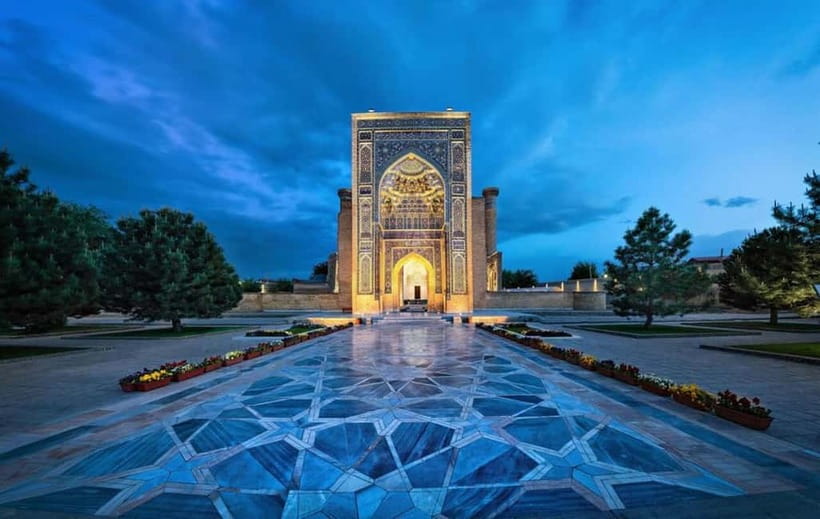
Gur Emir is one of the essential first stops in Samarkand. The mausoleum is associated with Timur, the 14th-century ruler whose empire made Samarkand a major center of power.
The building’s dome and tilework give you an immediate sense of the city’s grand style. Your guide can help you connect the monument’s design to the wider Timurid period, which makes the later sights easier to understand.
Registan Square
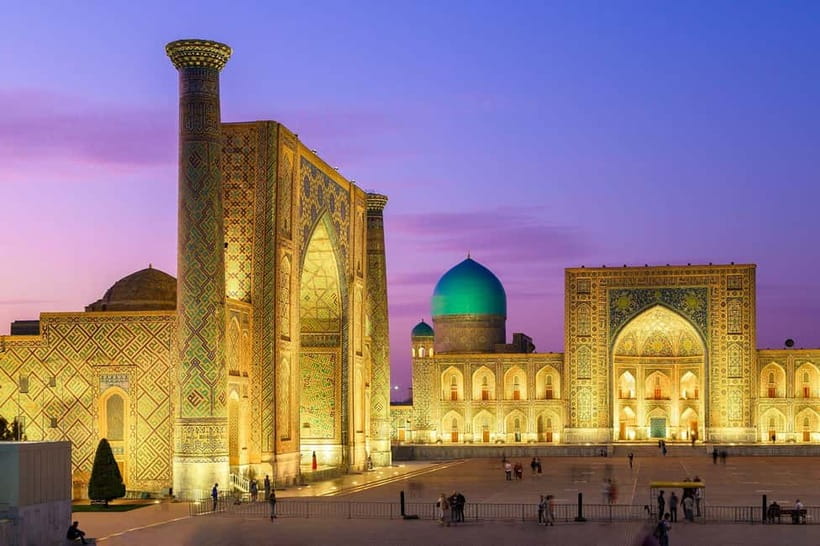
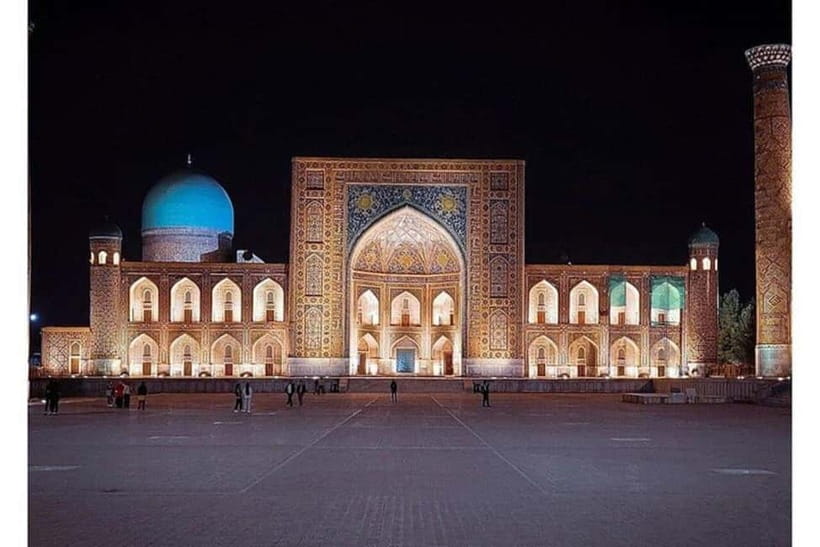
The Registan is the visual centerpiece of Samarkand. Three large madrasas frame the square with patterned tile, tall portals, and carefully balanced façades.
This is the place where the tour’s pace may work in your favor. A guide can point out details you might miss while taking in the scale, while the limited group size makes it easier to stay together than in a large coach party.
Allow yourself a moment to look beyond the main view. The square is famous for its grand composition, but the repeated geometric patterns and small decorative details reward a closer look.
Same city, a different kind of day:
- Best of Bukhara: All Day Private Old Town Tour
★ 5.0 · 66 reviews - Best of Bukhara: All Day Private Old Town Tour
★ 4.9 · 62 reviews - City Tour Around Bukhara
★ 5.0 · 55 reviews - Bukhara Full Day Old City Private Tour
★ 5.0 · 46 reviews
Bibi Khanym Mosque
Bibi Khanym Mosque gives you another sense of Samarkand’s ambition. Its enormous entrance and wide courtyard show the scale of religious architecture during the city’s powerful medieval period.
The visit pairs well with the Registan because the two sites show different sides of the city’s ceremonial architecture. You may want comfortable shoes here, as this day involves repeated stops, walking, and time on hard surfaces.
Siyob Bazaar
Siyob Bazaar brings a more everyday side of Samarkand into the day. Instead of only visiting monumental buildings, you get a look at the local market atmosphere and the food culture that supports the city.
The tour includes lunch, and delicious food is one of its stated draws. The available details do not specify a fixed restaurant or menu, so you should regard lunch as included rather than assume a particular dish or dining style.
This stop also helps break up a long series of monuments. You can see what people buy, notice the colors and textures of local produce, and take a short pause before continuing.
Shah-i-Zinda Ensemble
Shah-i-Zinda is a sequence of mausoleums and passageways known for its detailed tilework. It is among the most visually delicate places in Samarkand, with narrow spaces that contrast with the huge scale of the Registan and Bibi Khanym.
This is also one of the day’s more demanding walking stops. The route includes steps and uneven movement through the ensemble, so bring shoes that you can wear comfortably for hours.
Ulugh Beg Observatory
The Ulugh Beg Observatory connects Samarkand’s monumental past with scientific study. Ulugh Beg was a Timurid ruler and astronomer, and the site reflects the city’s role in the study of the stars as well as politics and religion.
By this point, you will have seen mosques, madrasas, mausoleums, a market, and a scientific site. That variety is one reason the program feels substantial even though the schedule is tight.
The evening train to Bukhara
After the Samarkand sightseeing program, you return to the railway station for the 21:43 train to Bukhara. The listed arrival time is 23:26, followed by a transfer to your hotel.
This is the toughest part of the first day. You begin before breakfast has fully settled, spend about eight hours touring, and reach your hotel late at night. The reward is that you wake up in Bukhara rather than lose another morning to a transfer.
Your Bukhara hotel is arranged in a double room at a property such as Amiran Boutique Hotel or Asia Bukhara, or a similar hotel. The package includes one night and breakfast, but the supplied details do not promise a particular room type beyond the stated double-room arrangement.
Day two: Bukhara’s lanes, courtyards, and minarets
Breakfast comes at the hotel before meeting your Bukhara guide at 09:00. The second day is another full sightseeing program, with the return train scheduled for 15:44.
That timing makes Bukhara feel packed. You have several important sites to see, but not much room for lingering over coffee, shopping, or independent exploration before leaving for the station at 15:00.
Lyab-i-Hauz Ensemble
Lyab-i-Hauz is one of Bukhara’s most recognizable gathering places. The ensemble is organized around a historic pool and includes buildings associated with the city’s religious and civic life.
It offers a different mood from Samarkand’s giant ceremonial squares. The setting is more compact, and the water-centered layout gives you a natural place to pause while your guide explains Bukhara’s past.
Nodir Devon Begi Madrasah
The Nodir Devon Begi Madrasah adds another fine example of Bukhara’s decorative architecture. Its façade and position near Lyab-i-Hauz make it an efficient stop within the old city program.
Here, your guide is especially useful for sorting out the many similar-sounding religious schools and historic buildings. Without context, a full day of madrasas can blur together. With a guide, you can connect each structure to its role and design.
Bolo-khauz Mosque
Bolo-khauz Mosque is included among the day’s central sights. Its setting and architectural details give you another view of Bukhara’s religious buildings, distinct from the larger Poi Kalyan complex later in the route.
The stop is part of a tightly connected city tour, so you are not spending the day on long transfers between distant places. That is helpful when your time in Bukhara is limited.
The Ark of Bukhara
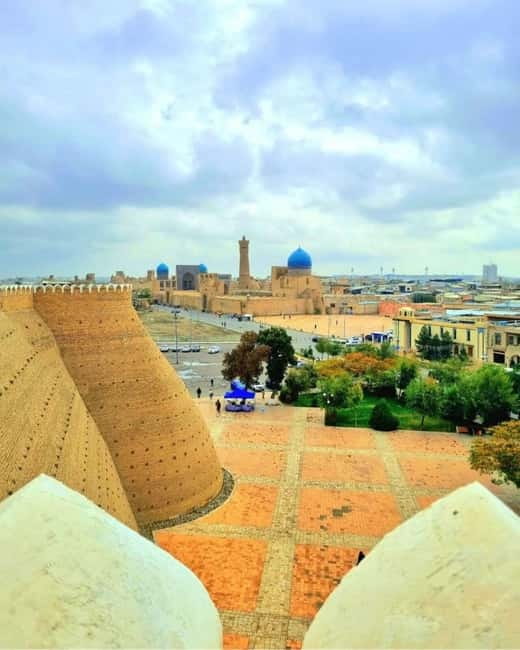
The Ark is Bukhara’s old fortified citadel and one of the city’s most important landmarks. Its massive walls suggest the political power once concentrated inside the compound.
This is a valuable counterpoint to the mosques and madrasas. The Ark helps explain Bukhara as a seat of rulers and administration, not simply as a collection of beautiful façades.
The Kalon Minaret and Poi Kalyan Mosque
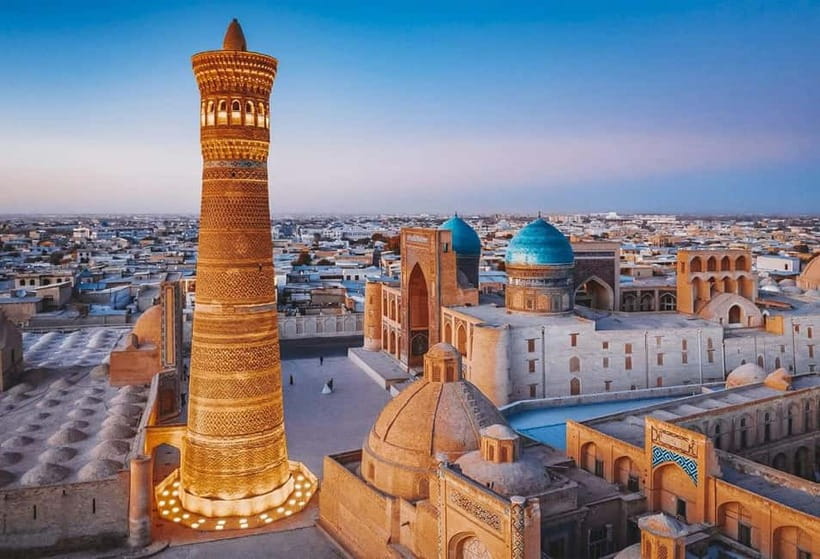
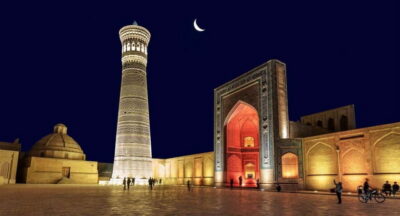
The Great Minaret of the Kalon is one of Bukhara’s defining sights. Its tall brick form differs from the colorful tiled buildings you see elsewhere, and its scale makes it easy to use as a point of orientation in the old city.
Poi Kalyan Mosque sits beside the minaret and forms one of Bukhara’s strongest architectural groupings. The visit gives you time to compare the city’s brickwork, courtyards, and tile decoration with Samarkand’s more monumental style.
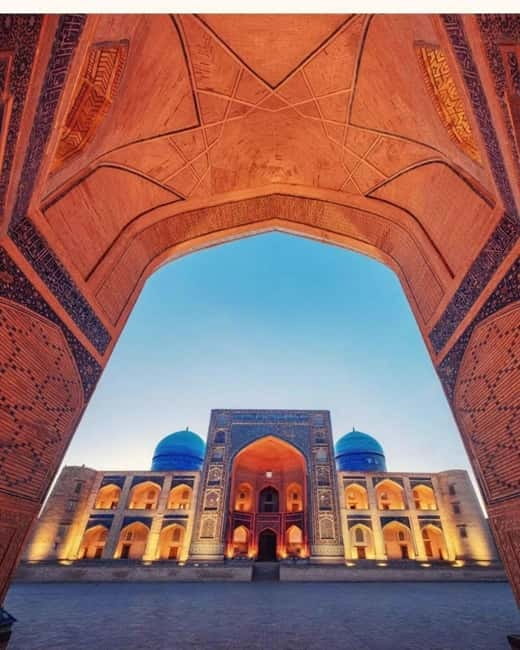
Mir-i-Arab Madrasa
Mir-i-Arab Madrasa completes the main Poi Kalyan area. Together with the minaret and mosque, it creates the classic Bukhara view that many people come to see.
The tour includes entrance fees to sights, museums, and mausoleums, which matters here because repeated ticket purchases can slow a short visit. You can focus on the explanations and photography instead of stopping to work out payment at every major site.
Chor-Minor and Ulugbek Madrasah
Chor-Minor is easy to recognize by its four small towers. It feels different from the large portals and broad courtyards elsewhere in Bukhara, which makes it a good late stop in a day filled with major monuments.
Ulugbek Madrasah links Bukhara back to the Timurid world you encountered in Samarkand. Seeing buildings connected to the same wider cultural period in both cities helps you understand that this is not two unrelated sightseeing stops. It is one connected regional story told through different urban settings.
What the $498 price covers
The $498 per-person price is easiest to judge as a package. It includes hotel-to-hotel transfers, air-conditioned vehicle transport, two high-speed train tickets between Tashkent and Samarkand and Bukhara and Tashkent, a regular train ticket from Samarkand to Bukhara, guides, entrance fees, one night in Bukhara, breakfast, and two lunches.
You also receive help at the stations and transfers to the hotel. For a short visit, that convenience has real value. Booking three train journeys, coordinating station pickups, buying admissions, arranging a hotel, and finding guides independently would take time and create several points where the schedule could fail.
The regular train from Samarkand to Bukhara is worth noting. The high-speed trains are used on the Tashkent routes, while the middle leg is listed as a regular economy-class train. That is not a problem, but you should not expect identical comfort on all three rail journeys.
The price becomes less attractive if you prefer to choose your own hotel, eat independently, or spend a full day in each city. It becomes more attractive if you have only a short window in Uzbekistan and want the main work handled for you.
The practical rhythm of the trip
This is a walking-heavy experience, especially in Bukhara. One guide was specifically praised for being kind and helpful because the city involved a lot of walking, so you should take that warning seriously.
Bring your passport or ID card for the train journeys and carry comfortable shoes. A small bag is easier than bulky luggage because you change cities, use several station transfers, and spend much of the day moving between sights.
The group limit of eight is a useful middle ground. You get the efficiency of a planned tour without the scale of a large bus group, and it should be easier to hear your guide and ask questions.
Train tickets require an important planning note. High-speed tickets may be unavailable when booked less than 60 days before departure, and the operator may substitute the most comfortable regular train class or another form of transport. If fast rail is a major reason you are booking, reserve early and confirm the final arrangements.
Free cancellation is available up to 24 hours before departure, and you can reserve now and pay later. Those terms help if your Uzbekistan schedule is still shifting, but they do not remove the need to check train availability.
Who should choose this tour?
I would choose this trip if you have already based yourself in Tashkent and want to see the country’s two headline cities without building a complicated transport plan. It is also a strong fit for first-time visitors who want guides to explain the monuments and station transfers handled from start to finish.
It suits solo visitors, couples, and small groups who value structure. The available guide languages make it useful for more than English-speaking visitors, and the group cap keeps the experience relatively personal.
I would be cautious about booking it if you dislike early starts, late arrivals, or fixed schedules. It is also a poor match if you want long museum visits, extended market time, or a relaxed evening in Bukhara.
The tour is not suitable for people over 95 according to the stated conditions. More broadly, you should be comfortable with a full day of sightseeing and considerable walking.
Should you book the Samarkand and Bukhara tour?
Book it if your priority is coverage. In two days, you see the central sights of both cities, travel by rail, sleep in Bukhara, eat two included lunches, and return to Tashkent without having to coordinate the moving parts yourself.
The strongest parts are the practical organization, small group size, and capable local guiding. Guides such as Aziz, Ikrom, Ikram, Nargiza, and Narguiza have been singled out for professionalism, friendliness, and good communication, though your assigned guides may differ.
Skip it if you can spare several extra days and want to set your own pace. For everyone else, $498 is a sensible price for a tightly planned introduction to Samarkand and Bukhara, provided you accept that the schedule leaves little room for idling.
FAQ
How long is the full experience?
The program lasts two days and includes one night in Bukhara. The stated eight-hour duration refers to the activity timing shown for the tour, not the complete door-to-door journey.
Where does the tour begin?
Pickup is in Tashkent, with hotel pickup included. You need to provide your hotel location so the transfer can be arranged.
Which cities does the tour visit?
The route visits Samarkand and Bukhara, beginning and ending in Tashkent.
What trains are included?
The package includes high-speed economy-class tickets from Tashkent to Samarkand and from Bukhara to Tashkent. The Samarkand to Bukhara journey uses a regular economy-class train.
What happens if high-speed train tickets are unavailable?
If high-speed tickets cannot be obtained, they may be replaced with the most comfortable class of regular train tickets or with transport.
Is hotel accommodation included?
Yes. One night in Bukhara is included, usually in a double room at Amiran Boutique Hotel, Asia Bukhara, or a similar property.
Are meals included?
The package includes one breakfast and two lunches. Other services or meals not listed are not included.
Which languages are available for the guide?
Guides are available in English, French, German, Italian, and Russian.
How many people are in the group?
The tour is a small-group experience limited to eight participants.
What should I bring?
Bring your passport or ID card. Comfortable shoes are also a practical choice because the Bukhara sightseeing program involves substantial walking.
Just added in Bukhara
- 9 Days Private Guided Tour to Uzbekistan★ 5.0 · 3 reviews
- Bukhara Countryside Private Tour with Transport★ 5.0 · 6 reviews
- 2 Days Private Safari Tour from Bukhara★ 4.5 · 6 reviews
- Private Bukhara-Khiva Transfer via Ancient Fortresses★ 4.5 · 8 reviews
- A Group Walking Tour Of Old Town★ 5.0 · 8 reviews
- Bukhara: Walking Tour with a Small Group★ 5.0 · 10 reviews
- Bukhara: Private Guided Walking Tour with Hotel Pickup★ 5.0 · 11 reviews
- Bukhara Traditional Men’s Hammam / Bath XVI Century★ 3.9 · 11 reviews
Tours in Bukhara, compared.
All You Need To Know About Bukhara. A Walk In The Town
Read our review →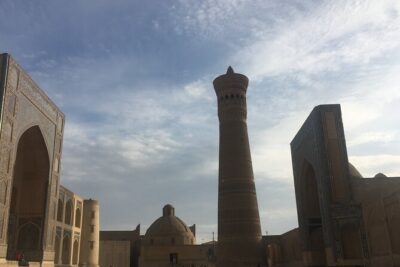
Bukhara Historical City Highlights Guided Walking Tour
Read our review →
Beyond the Walls: Countryside Tour with Transport and Lunch
Read our review →
Hiking tour to Hayat, Uhum and Asraf villages – 4 days
Read our review →Browse the lists this tour appears in