
Reviewed · CITY TOURS
City Tour Around Bukhara
Bukhara is best understood not just through its grand monuments, but through the people still making things inside them. This tour pairs the Ark, Kalon Minaret, trading domes, and ancient mausoleums with working crafts, local food, music, and stories about daily life. I especially like the handmade messages from the past, a small but memorable keepsake, and Kamilla’s promise to explain without burying you in dates.
I also like the flexible shape of the day. You can ask for a plov stop, spend longer with artisans, or arrange a traditional cooking or bread-making lesson. The main consideration is pace: with 11 stops and several paid admissions, this can run close to six hours, and the grand total will be higher than the advertised group price if you add entrance fees, food, or tea.
Key points at a glance
- A private tour for up to six: The $66 group price can be strong value for a family or small party, since it is not charged per person.
- Kamilla Yu leads the experience: Her conversational English and easygoing style suit visitors who want both history and everyday Uzbek culture.
- Monuments and living crafts share the day: You may see puppets, blacksmithing, gold embroidery, fabric making, and wood carving alongside the major sights.
- The route crosses Bukhara’s historic core: It begins near the Ismail Samani Mausoleum and ends at Lyab-i-Hauz, a useful central finish.
- The handmade messages are unusual: These personal souvenirs are included and give the tour a creative touch.
- Plan for a long half-day: The advertised duration is 4 to 6 hours, with breaks for coffee and tea and several optional additions.
A personal way to meet Bukhara
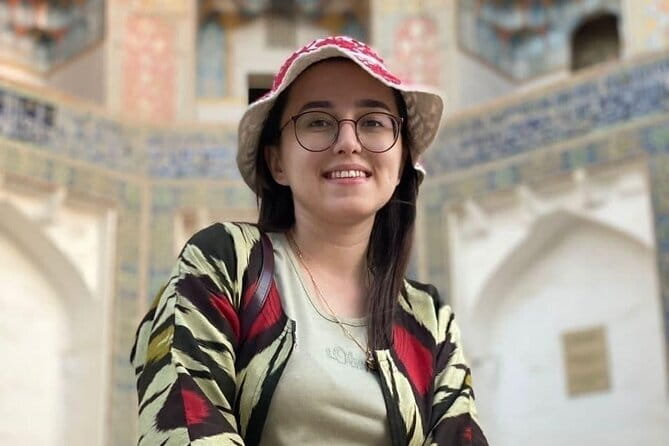
Kamilla Yu’s tour is built around a simple idea: show you the famous buildings, then connect them to the crafts, customs, food, and stories that give Bukhara its character today. That makes it different from a monument-only walk.
You will have a private guide for your own group, rather than sharing the day with strangers. The group limit is six people, which is small enough for questions and practical adjustments. Several people who took the tour praised Kamilla’s conversational English, careful preparation, patience with photographs and shopping, and willingness to adapt the schedule.
Her approach is light on long lists of rulers and heavy on short explanations. If you want every date and dynasty, you may need to ask for extra detail. If you prefer clear context, personal stories, and links between old Bukhara and present-day Uzbekistan, the format should suit you well.
The advertised price is $66 per group, not per person. For two people, that is $33 each. For six, it works out to $11 each before admissions and extras, which is a good deal for a private 4 to 6 hour outing. Check the cost of entrance tickets as you plan, since admissions are not included at several important stops.
Other city tours in Bukhara:
- Bukhara Full Day Old City Private Tour
★ 5.0 · 46 reviews - Bukhara Historical City Highlights Guided Walking Tour
★ 4.5 · 16 reviews - Khiva: Historical City Highlights Guided Walking Tour
★ 4.8 · 156 reviews
Starting with the brickwork of Ismail Samani
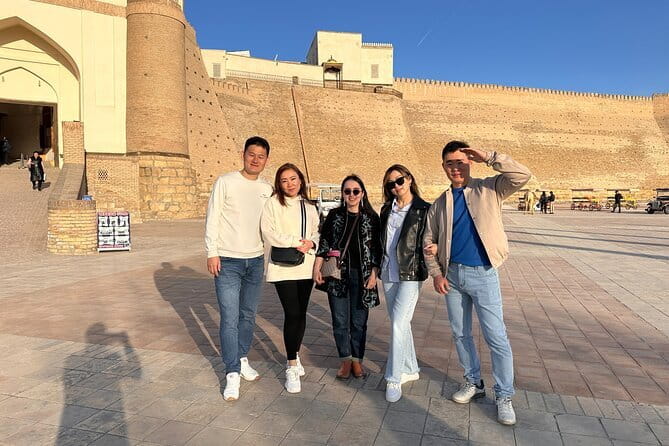
The meeting point is the Ismail Samani Mausoleum, where the tour begins with one of Bukhara’s most striking early buildings. This 9th or 10th-century mausoleum is made from brick, with no colorful tile surface to distract from its structure.
The clever part is the brickwork. More than 20 laying patterns were used, creating shifting light and shadow across the walls. It is a good first stop because you can study the building itself instead of simply looking for bright decoration.
Allow about 30 minutes here. Admission is not included, so confirm the current fee when booking or arriving. The start point is outside the central Lyab-i-Hauz area, and pickup is offered, but the meeting details list the mausoleum as the starting location. Clarify pickup arrangements in advance if you do not want to make your own way there.
Sacred water and three religious traditions
Chashmai Ayub Mausoleum takes you to a place connected with the Prophet Job, known locally as Ayub. The complex dates to the 12th century and includes a natural well whose water has been associated with healing skin conditions.
The site matters for more than one faith. It is described as holy to three religions, and the tour also points out how Bukhara’s religious past overlaps in unexpected ways. This is a quieter stop than the Kalon complex, with around 20 minutes scheduled.
Admission is not included. You will want to treat the well and religious setting with respect, especially if other people are praying or observing local customs.
Bolo Hauz and the story behind forty pillars
Bolo Hauz Mosque is known for its carved wooden pillars. The building has 20 pillars, yet people call it a 40-pillar mosque. Kamilla uses that detail to explain how the structure was seen and counted, rather than leaving you with a name to remember and no context.
This is also where you hear about the mosque’s public role. Its setting was connected with announcing news about a new ruler, giving the building a place in civic life as well as religious life.
The visit takes about 30 minutes, and admission is listed as free. The carved wood gives you a welcome change from the brick, tile, and plaster found elsewhere on the route.
Same city, a different kind of day:
- Best of Bukhara: All Day Private Old Town Tour
★ 5.0 · 66 reviews - Best of Bukhara: All Day Private Old Town Tour
★ 4.9 · 62 reviews - Yurt Camp Tour with Night from Bukhara
★ 3.8 · 35 reviews - All You Need To Know About Bukhara. A Walk In The Town
★ 4.9 · 31 reviews
Inside the Ark of Bukhara
The Ark is the tour’s big fortress stop. It served as the seat of Bukhara’s rulers from the 4th century BC until 1920, though what you see today includes ruins as well as restored or surviving sections.
Expect about 40 minutes here. You will learn how the citadel functioned and reach a point with a city view. The Ark is large enough to benefit from a guide because a bare walk through its walls can leave you wondering what each space once did.
Admission is not included. The ruins and uneven historic surfaces may make this stop less comfortable for anyone who has difficulty walking, although the supplied information says most people can participate. Give yourself time for photographs, but remember that the itinerary has many more stops ahead.
The Kalon Minaret and the mosque of 288 domes
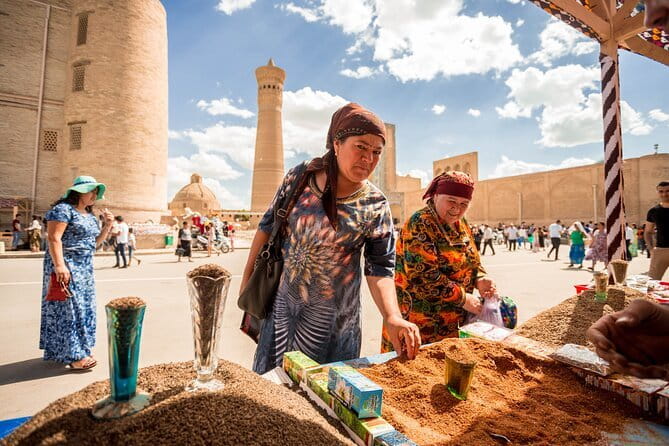
The Great Minaret of the Kalon is one of Bukhara’s unmistakable landmarks. Built in the 12th century, it has survived while much around it changed. The tour explains its strength and earlier uses, rather than treating it as a simple photo stop.
The minaret is especially appealing in the evening, when it is illuminated. Summer evening tours are available, so ask about that option if you want to see the monument after dark. The standard schedule is listed as Monday through Friday, 9:00 a.m. to 6:00 p.m., but evening availability is specifically offered during summer.
Next comes Poi Kalyan Mosque, still active and dating from the 16th century. Its 288 domes make it a rewarding place to slow down and look upward. The schedule allows 25 minutes at the mosque and 25 minutes at the minaret.
Admission to the mosque is not included, while the minaret and Mir-i-Arab Madrasa are listed as free. Rules at active religious sites can change, so dress and behave respectfully. The mosque is not just a grand photograph. It remains a working place of worship.
Mir-i-Arab Madrasa and religious education
Mir-i-Arab Madrasa has continued to function as a religious college since the 16th century. The tour explains how religious education worked and how a madrasa was typically constructed.
This stop is useful if you want the buildings to make sense as institutions, not just as decorative façades. You will spend about 25 minutes here. Admission is listed as free, but access inside religious colleges can sometimes depend on current conditions, so follow the guide’s instructions.
The nearby Kalon complex can feel like the visual center of Bukhara. Kamilla’s explanations help connect the minaret, mosque, and madrasa as parts of one important religious and civic setting.
Three trading domes and the business of the Silk Road
The trading domes give you a practical look at old commerce. You will pass through three domed markets, each associated with a different purpose. The point is not only to browse souvenirs, but to understand how merchants organized goods, customers, and profit.
About 40 minutes is scheduled here. That is enough for an explanation and some shopping, though you may want longer if you are looking for textiles, crafts, or other keepsakes. One of the strengths of a private tour is the ability to tell Kamilla whether you want to shop seriously or keep moving.
This is also a good place to connect the grand Silk Road story with ordinary transactions. Merchants needed shade, predictable routes, storage, and places where buyers knew what to find. The domes show that trade was structured, not random.
Kosh Madrasah and two styles in one square
Kosh Madrasah brings together two different madrasas in the same square. Their styles differ, and the tour points out an original 17th-century classroom and a mosque described as cave-like.
You will also hear about two major religious streams and how they relate to the buildings. That makes this a stop for travelers who enjoy comparing architecture and ideas rather than collecting one more landmark name.
The visit is planned for around 40 minutes. Admission is not included. Since the route already contains a lot of architecture, Kamilla’s short, clear explanations are important here. Without them, the similarities between madrasas can blur together.
Magoki Attori, a mosque below street level
Magoki Attori Mosque is one of the route’s more unusual stops. The 12th-century mosque sits deeply below the surrounding level, reflecting how the ground and city have changed over time.
The site also connects two forms of worship. It was once used by both Jewish and Muslim communities, an important reminder that Bukhara’s religious life was not limited to one tradition.
The stop lasts about 20 minutes and includes a carpet museum. Admission is not included. If you enjoy textiles, allow a little time to look closely rather than rushing through for another photograph.
Finishing at Lyab-i-Hauz
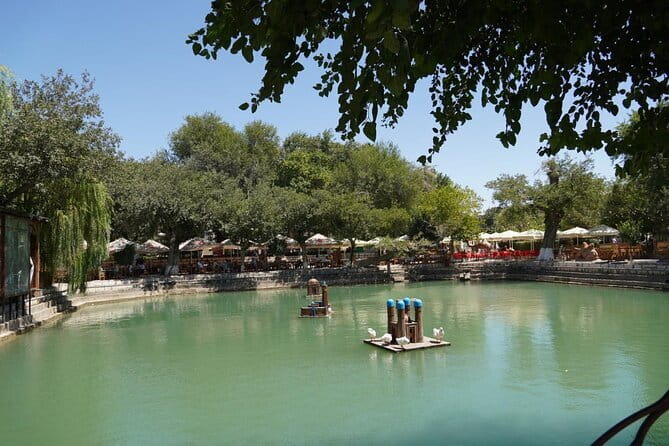
The tour ends at Lyab-i-Hauz, the heart of Bukhara’s old center. The complex includes a mosque, two distinctive madrasas, and a caravanserai, the old roadside hotel used by merchants and other people crossing the region.
The pond gives the square its name and provides a natural place to pause after several hours of monuments. The tour allows about 30 minutes here, with admission listed as free.
Ending at Lyab-i-Hauz is practical. You finish in a central part of the historic city instead of being returned to a remote starting point. You can continue exploring, eat nearby, or use the square as a reference point for the rest of your stay.
Crafts, food, music, and small surprises
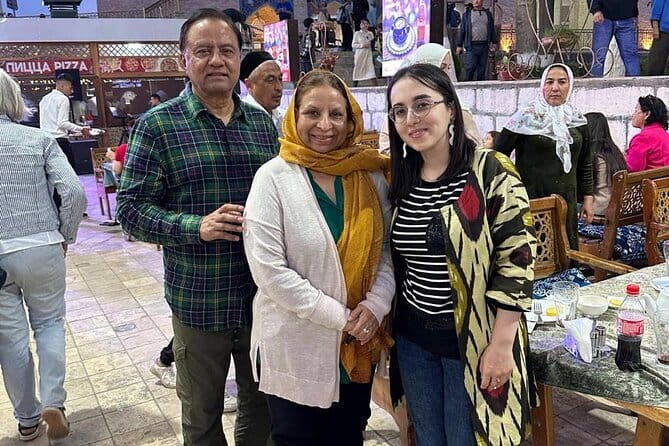
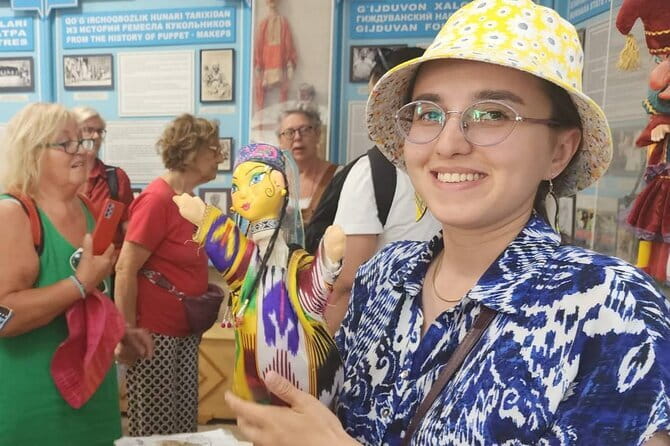
The monuments are only half of the appeal. Kamilla can show you the working process behind puppets, blacksmithing, gold embroidery, fabric making, wood carving, and other crafts. Seeing hands at work gives you a better sense of local skill than simply buying a finished object in a shop.
You can also request a masterclass in preparing a traditional meal or baking bread. The information does not promise that every option is part of the base price, so ask what can be arranged and what costs extra.
Local food stops are possible, including a plov lunch. Coffee and tea breaks are part of the tour rhythm, but coffee and tea are not included in the price. Local music, traditions, and folk shows may also be arranged, depending on what you choose.
The handmade messages from the past are included. They are not a major financial benefit, but they give the outing a personal signature and make the experience feel less like a standard list of sights.
Timing, transport, and the real cost
The tour is advertised at 4 to 6 hours, but the listed stop times add up to roughly six hours before walking, transport, shopping, meals, and breaks. If you want the full program, plan on the longer end.
Pickup is offered, and the tour is near public transportation. The listed start is the Ismail Samani Mausoleum, while the finish is Lyab-i-Hauz. Confirm the exact pickup point and whether any vehicle transfer is involved before the day begins.
The $66 price covers the private guide and handmade messages from the past. It does not cover several admissions, coffee or tea, food, or optional workshops. For a full group of six, it is excellent value. For one or two people, it is pricier per head, but you gain privacy and the ability to adjust the pace.
Free cancellation is available up to 24 hours before the start time. Changes made inside that window are not accepted, and poor weather can lead to a new date or full refund. The experience requires good weather.
Who should book this Bukhara tour?
I would choose this tour if you want Bukhara’s essential monuments explained in plain language, with room for questions about modern Uzbek life. It is particularly suitable for couples, families, and small groups who value a private guide and may want to add food or craft experiences.
It is also a good match if you have limited time in Bukhara. In one long half-day, you cover the city’s major religious buildings, fortress, trading domes, and central square.
You may prefer a different format if you want a slow museum day, a strictly academic lecture, or a short walk with only two or three sights. The route is full, and some admissions are extra. Ask Kamilla to trim the list if you would rather spend more time with artisans or at lunch.
Should you book it?
Book this tour if you want the main sights plus a human connection to Bukhara’s crafts, food, faith, and daily life. Kamilla’s flexible style, strong conversational English, and willingness to adjust for lunch, shopping, photographs, and personal interests are the main reasons to choose it.
The best value comes with four to six people. Couples can still find it worthwhile, especially if they want a private day and a guide who can connect ancient monuments with modern Uzbekistan. Just budget for admissions and extras, and allow the full six hours if you want to enjoy the route rather than hurry through it.
FAQ
Where does the tour start?
The listed start point is the Ismail Samani Mausoleum in Bukhara, Uzbekistan.
Where does the tour end?
It ends at Lyab-i-Hauz, also called Lyabi Khause Square, in the center of Bukhara’s old part of the city.
How long does the tour last?
The expected duration is approximately 4 to 6 hours. The full route has 11 stops, so the longer timing is likely if you take breaks, shop, or add food and craft activities.
How many people can join?
This is a private activity for your group, with up to six people included in the group price.
Is pickup available?
Yes, pickup is offered. The listed meeting point is still the Ismail Samani Mausoleum, so confirm the exact pickup arrangement when booking.
Are entrance tickets included?
No. Admission is not included at several stops, including the Ismail Samani Mausoleum, Chashmai Ayub Mausoleum, Ark of Bukhara, Poi Kalyan Mosque, Kosh Madrasah, and Magoki Attori Mosque and Carpet Museum. Bolo Hauz Mosque, the Great Minaret of the Kalon, Mir-i-Arab Madrasa, the trading domes, and Lyab-i-Hauz are listed as free.
Are food, coffee, and tea included?
Coffee and tea are not included. A local food stop, plov lunch, or traditional cooking and bread-making lesson may be arranged, but confirm the details and any extra cost.
Who guides the tour?
The experience is provided by Kamilla Yu, a private tour guide in Bukhara.
Can the tour be canceled for a refund?
You can cancel at least 24 hours before the start time for a full refund. Cancellations or changes made less than 24 hours before the experience are not accepted for a refund. If poor weather causes the tour to be canceled, you will be offered another date or a full refund.
Just added in Bukhara
- 9 Days Private Guided Tour to Uzbekistan★ 5.0 · 3 reviews
- 2 – Days Guided Tour of Samarkand and Bukhara from Tashkent★ 5.0 · 5 reviews
- Bukhara Traditional Men’s Hammam / Bath XVI Century★ 3.9 · 11 reviews
- Bukhara Countryside Private Tour with Transport★ 5.0 · 6 reviews
- 2 Days Private Safari Tour from Bukhara★ 4.5 · 6 reviews
- A Group Walking Tour Of Old Town★ 5.0 · 8 reviews
- Private Bukhara-Khiva Transfer via Ancient Fortresses★ 4.5 · 8 reviews
- Bukhara: Walking Tour with a Small Group★ 5.0 · 10 reviews
City Tours, compared.
Private Samarkand City Tour With Transportation
Read our review →
A City Tour Of Samarkand: The Pearl Of The East
Read our review →
Private Guided Tour Samarkand city history and culture
Read our review →
Samarkand City Tour with a Professional Photographer
Read our review →
Browse the lists this tour appears in